Vega-C Launches SMILE Mission for ESA — 19 May 2026 Recap
Published · Updated
Vega-CSMILEESAAvio✓ recap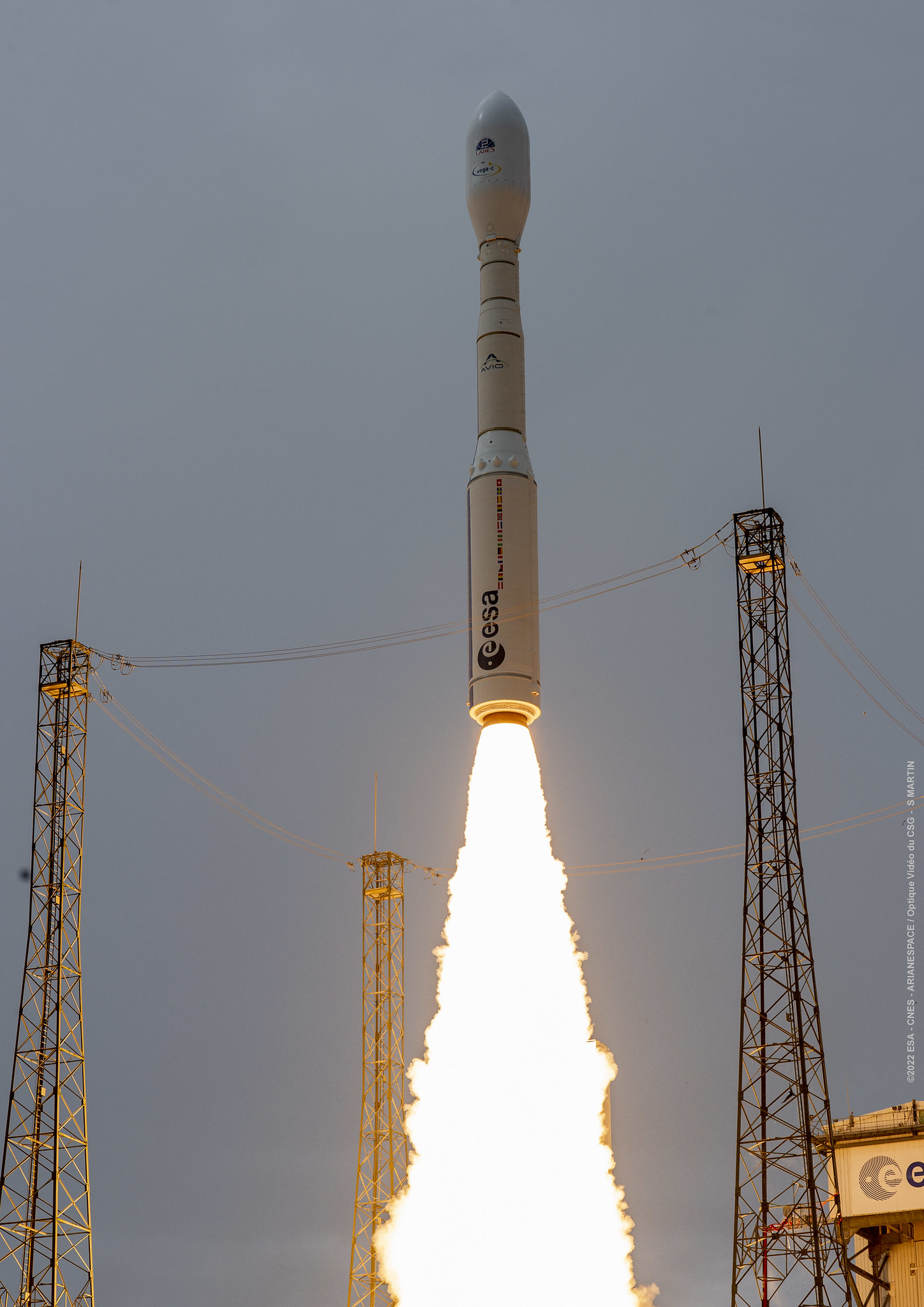
Launch facts
| Rocket | Vega-C |
| Operator | Avio S.p.A |
| Pad | Ariane Launch Area 1 (ELV), Guiana Space Centre, French Guiana |
| T-0 (UTC) | 19 May 2026 at 03:52 |
| Status | Success |
What happened?
A Vega-C rocket successfully launched the Solar wind Magnetosphere Ionosphere Link Explorer (SMILE) spacecraft on 19 May 2026 at 03:52:10 UTC from the Ariane Launch Area 1 (ELV) at the Guiana Space Centre in French Guiana. The mission, operated by Avio S.p.A, marked a return-to-flight-class demonstration of Europe's four-stage light-lift vehicle and delivered a joint European Space Agency and Chinese Academy of Sciences science satellite toward its target orbit.
Vega-C is a solid-fuelled small launcher standing about 35 metres tall, capable of lofting roughly 2,300 kg to a 700 km polar orbit. SMILE is a space-weather observatory designed to image, for the first time in soft X-rays and ultraviolet, how the solar wind interacts with Earth's magnetosphere.
Did the launch succeed?
Yes. The launch was declared a success, with Vega-C's P120C first stage, Zefiro-40 second stage, Zefiro-9 third stage and liquid-fuelled AVUM+ upper stage performing the ascent and orbital injection sequence. The AVUM+ upper stage is responsible for the precise final burns that place payloads into their target orbits.
What is Vega-C?
Vega-C is the upgraded evolution of the original Vega, developed by Avio and operated in cooperation with the European Space Agency. Its powerful P120C solid-rocket motor is shared with the boosters of Europe's larger Ariane 6, giving the family commonality across manufacturing lines. Vega-C is optimised for small and medium scientific payloads to low Earth and Sun-synchronous orbits, a niche SMILE fits precisely.
What is the SMILE payload?
SMILE is a joint mission between the European Space Agency (ESA) and the Chinese Academy of Sciences (CAS), the first large-scale collaborative science satellite between the two institutions. Its purpose is to study the continuous interaction between the charged particles of the solar wind and Earth's protective magnetic bubble, the magnetosphere.
The spacecraft carries four instruments:
- Soft X-ray Imager (SXI) — captures wide-field images of the boundaries where solar wind meets the magnetosphere.
- Ultraviolet Imager (UVI) — observes the northern auroral oval to track how energy flows into the atmosphere.
- Light Ion Analyser (LIA) — measures the density and speed of solar wind ions.
- Magnetometer (MAG) — records local magnetic field changes.
SMILE is designed to operate from a highly elliptical orbit that keeps it above the northern hemisphere for long, uninterrupted observing windows, allowing it to watch entire space-weather storms unfold rather than snapshot fragments.
Why does this mission matter?
Space weather driven by the solar wind can disrupt satellites, power grids, aviation routes and communications. By imaging the global response of the magnetosphere continuously, SMILE aims to improve forecasting models the way weather satellites transformed terrestrial meteorology. According to ESA's mission overview, SMILE is the first spacecraft engineered to simultaneously image the magnetopause, the polar cusps and the auroral oval in a single field of view.
Where did it launch from?
The mission lifted off from the Guiana Space Centre near Kourou, French Guiana, using the Ariane Launch Area 1 site adapted for Vega-class vehicles. The equatorial location, at roughly 5 degrees north latitude, gives European launchers an efficiency boost for many orbital inclinations and has served as Europe's primary spaceport since 1968.
Launch summary
| Detail | Value |
|---|---|
| Rocket | Vega-C |
| Operator | Avio S.p.A |
| Payload | SMILE (ESA / CAS) |
| Launch time | 19 May 2026, 03:52:10 UTC |
| Site | Ariane Launch Area 1, French Guiana |
| Result | Success |
How to track SMILE and future launches
You can follow SMILE and thousands of other spacecraft on Cosmik's live 3D solar-system and satellite map, and check upcoming missions on our rocket launch schedule. For more mission coverage, visit the latest launch news, and learn the basics on our satellite tracking guide.
Background on the vehicle, operator and spaceport is available on Wikipedia for Vega-C, the Guiana Space Centre, and the SMILE mission. Launch data is sourced from The Space Devs Launch Library API.
Follow it live on Cosmik
Track SMILE in orbit right now on Cosmik's real-time 3D map and enable free launch alerts so you never miss the next liftoff. Watch the whole solar system come alive at gocosmik.com.
Follow this mission live in 3D and get a free alert before liftoff.
Open the live map →Sources
Next launches
- Dragon CRS-2 SpX-35 — launch time & how to watch — 13 October 2026, 10:33 UTC
- Martian Moon eXplorer (MMX) — launch time & how to watch — 19 October 2026, 19:41 UTC
- Amazon Leo (LV-01) — launch time & how to watch — 29 October 2026
More launch coverage
- Electron 'Viva La StriX' Launch Recap: Success on 22 May 2026 — 22 May 2026, 09:33 UTC
- Falcon 9 Starlink Group 10-31: Launch Success (21 May 2026) — 21 May 2026, 10:04 UTC
- Starlink Group 17-42 Launch Recap: Falcon 9 Succeeds May 20, 2026 — 20 May 2026, 02:46 UTC
- Long March 8 Launches SpaceSail Polar Group #9 — 17 May 2026 Recap — 17 May 2026, 14:42 UTC
- Falcon 9 Dragon CRS-2 SpX-34 Launch Success — 15 May 2026 — 15 May 2026, 22:05 UTC
- Kinetica 1 Launches 5 Satellites — 15 May 2026 Recap — 15 May 2026, 04:33 UTC