Total Solar Eclipse — August 12, 2026
0 days to go — the first totality over mainland Europe since 1999.
On Wednesday, August 12, 2026, a total solar eclipse will cross western Greenland, Iceland and northern Spain — the first total eclipse visible from mainland Europe since 1999. Totality lasts up to about 2 minutes 18 seconds (western Iceland ~17:48 GMT, northern Spain in the low evening sun ~20:26 local). And the same night, the Perseid meteor shower peaks under a moonless sky— the best conditions since 2018. One date, two of the decade's best sky events.
🌑 🌑 Total solar eclipse, August 12 — 0 days away
One or two emails before the 12th: the exact timing for your area, how much of the Sun you'll see, and how to watch it safely. Nothing else, unsubscribe in one click.
Free · no account · unsubscribe anytime
✈ TelegramWhere can you see totality?
- Iceland — the path crosses the west of the island, Reykjavík region included: afternoon sky, weather permitting.
- Northern Spain — the shadow sweeps from the Atlantic coast across the north of the country toward the Mediterranean and the Balearic Islands, in the low evening sun. A clear western horizon is essential.
- Greenland & the Arctic — for expedition travellers, the longest totality of this eclipse.
- Everywhere else in Europe — a strong partial eclipse: the further north and west, the deeper the bite out of the Sun.
City guides — is it total where you are?
- Reykjavík — ~1 min of totality, afternoon sky
- Oviedo (Asturias), Bilbao, Zaragoza, Valencia, Palma de Mallorca — the Spanish totality corridor, low evening sun
- Madrid & Barcelona — ~99% partial: spectacular, but not total (and why that 1% changes everything)
- Berlin, Munich, Hamburg, Cologne, Frankfurt, Stuttgart, Düsseldorf, Dortmund, Leipzig, Bremen — Germany sees a deep ~85–89% partial, the Sun very low near sunset (not total)
Читаете по-русски? Смотрите гид по затмению для городов России.
Every European city — your exact coverage
We computed the local circumstances (obscuration, maximum time and the Sun's altitude) for every European city where the eclipse is above the horizon — 145more cities beyond the guides above. Percentages are the share of the Sun's area covered at maximum; where the Sun is very low, the partially eclipsed Sun sets during the event.
Algeria: Algiers (~99%) · Oran (~95%)
Austria: Innsbruck (~90%) · Salzburg (~89%) · Linz (~88%)
Belgium: Brussels (~89%) · Antwerp (~89%) · Ghent (~89%)
Czechia: Prague (~86%)
Denmark: Aarhus (~84%) · Copenhagen (~83%)
Estonia: Tallinn (~80%)
Finland: Utsjoki (~82%) · Ivalo (~81%) · Inari (~81%) · Saariselkä (~81%) · Nellim (~81%) · Levi (~81%) · Äkäslompolo (~81%) · Helsinki (~80%) · Tampere (~80%) · Turku (~80%) · Rovaniemi (~80%)
France: Toulouse (~98%) · Bordeaux (~97%) · Marseille (~96%) · Nantes (~96%) · Montpellier (~96%) · Brest (~96%) · Nice (~95%) · Rennes (~95%) · Lyon (~94%) · Grenoble (~94%) · Tours (~94%) · Paris (~92%) · Rouen (~92%) · Reims (~91%) · Strasbourg (~90%) · Lille (~90%)
Germany: Freiburg (~90%) · Karlsruhe (~89%) · Mannheim (~89%) · Augsburg (~89%) · Aachen (~89%) · Essen (~88%) · Nuremberg (~88%) · Wuppertal (~88%) · Bonn (~88%) · Wiesbaden (~88%) · Mönchengladbach (~88%) · Gelsenkirchen (~88%) · Krefeld (~88%) · Mainz (~88%) · Münster (~87%) · Bielefeld (~87%) · Erfurt (~87%) · Dresden (~86%) · Hanover (~86%) · Braunschweig (~86%) · Chemnitz (~86%) · Halle (~86%) · Magdeburg (~86%) · Kiel (~85%) · Lübeck (~85%)
Iceland: Akureyri (~98%) · Grímsey (~98%)
Ireland: Cork (~96%) · Galway (~96%) · Dublin (~94%)
Italy: Turin (~93%) · Genoa (~93%) · Milan (~92%) · Verona (~92%)
Latvia: Riga (~80%)
Luxembourg: Luxembourg (~89%)
Morocco: Tangier (~92%) · Fes (~90%) · Rabat (~88%) · Casablanca (~87%) · Marrakesh (~83%) · Agadir (~80%)
Netherlands: Rotterdam (~89%) · The Hague (~89%) · Amsterdam (~88%) · Utrecht (~88%) · Eindhoven (~88%) · Groningen (~87%)
Norway: Bergen (~85%) · Stavanger (~85%) · Oslo (~83%) · Trondheim (~83%) · Tromsø (~83%) · Narvik (~83%) · Bodø (~83%) · Svolvær (~83%) · Finnsnes (~83%) · Hansnes (~83%) · Alta (~82%) · Kirkenes (~81%)
Poland: Wrocław (~85%) · Poznań (~84%) · Gdańsk (~82%)
Portugal: Porto (~98%) · Lisbon (~95%) · Funchal (~78%)
Spain: Alicante (~99%) · Granada (~96%) · Seville (~95%) · Málaga (~95%) · Las Palmas (~70%) · Santa Cruz de Tenerife (~70%)
Sweden: Gothenburg (~83%) · Malmö (~83%) · Abisko (~82%) · Kiruna (~82%) · Jukkasjärvi (~82%) · Stockholm (~81%) · Luleå (~81%)
Switzerland: Geneva (~93%) · Lausanne (~92%) · Basel (~91%) · Bern (~91%) · Zurich (~90%)
UK: Plymouth (~94%) · Bristol (~93%) · Cardiff (~93%) · Belfast (~93%) · Birmingham (~92%) · Liverpool (~92%) · Southampton (~92%) · Portsmouth (~92%) · Brighton (~92%) · Oxford (~92%) · London (~91%) · Manchester (~91%) · Glasgow (~91%) · Leeds (~91%) · Sheffield (~91%) · Nottingham (~91%) · Leicester (~91%) · Cambridge (~91%) · Edinburgh (~90%) · Newcastle (~90%) · York (~90%) · Aberdeen (~89%)
Then stay out for the Perseids 🌠
The eclipse happens because the Moon is new — which means the night of August 12-13 is also moonless, exactly when the Perseidspeak at up to ~100 meteors per hour. It's the shower's best year since 2018: after the eclipsed sunset, find a dark spot, face northeast, give your eyes 20 minutes, and the shooting stars do the rest. No equipment needed — meteors and satellite passes are naked-eye shows.
How to watch safely
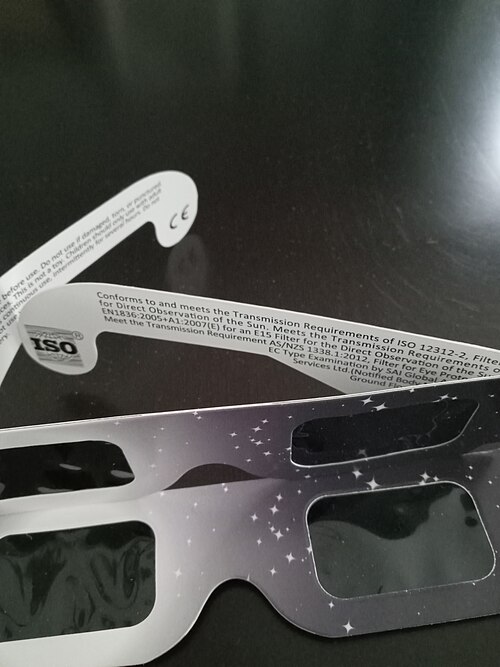
Certified ISO 12312-2 eclipse glasses at all times outside totality — ordinary sunglasses do not protect your eyes, and neither does a phone camera pointed at the Sun. Only during the brief window of full totality, inside the path, is naked-eye viewing safe (and unforgettable: the corona, stars at dusk, a 360° sunset).
Your countdown checklist — 0 days to go
- Now: order your ISO-certified eclipse glasses — in 2017 and 2024 certified stock sold out 1-2 weeks before the eclipse, and last-minute marketplace listings are where the counterfeits live.
- Now, if you're chasing totality:book accommodation in the path (Iceland or northern Spain) — the band is only ~290 km wide and hotels inside it fill months ahead. Check your city's exact coverage in the city guides.
- 1 week before: scout your spot — a clear western horizon matters because the eclipse happens low in the evening sky for most of Europe. Test your glasses on the normal Sun (you should see a crisp orange disk and nothing else).
- The day before: check cloud forecasts and be ready to drive — mobility is the #1 predictor of actually seeing totality.
- August 12: arrive early, glasses on outside totality, and stay out after dark for the Perseids — best meteor year since 2018, same moonless night.
- Don't want to think about it? Set a free Cosmik alertand we'll ping you at the right moments.
Frequently asked questions
Where will the August 12, 2026 total solar eclipse be visible?
The path of totality crosses the Arctic, western Greenland, Iceland (including the Reykjavík region) and northern Spain, ending near the Mediterranean around sunset. A partial eclipse will be visible across nearly all of Europe, North Africa and parts of northeastern North America.
What time is the eclipse on August 12, 2026?
Totality reaches western Iceland around 17:48 GMT (about a minute of darkness near Reykjavík) and sweeps into northern Spain in the evening — around 20:26 local time in Asturias, with the eclipsed Sun very low over the western horizon. Maximum totality is about 2 minutes 18 seconds. Open Cosmik for a live countdown for your location.
Is the eclipse total in Madrid or Barcelona?
No — Madrid and Barcelona sit just outside the path and see a ~99% partial eclipse: dramatic, but never fully dark, and never safe without glasses. For true totality you need the path itself: the Asturias–Zaragoza–Valencia–Palma corridor or western Iceland. London sees ~91% partial, Paris ~92%.
What are the Perseids, and why is 2026 special?
The Perseid meteor shower — up to ~100 meteors per hour — peaks the very same night, August 12-13, 2026. And because the eclipse requires a new moon, the sky stays moonless all night: the best Perseid viewing conditions since 2018. Eclipse at dusk, meteor storm after dark — one night, two shows.
Do I need eclipse glasses?
Yes — at every moment except the brief window of totality itself, looking at the Sun without certified ISO 12312-2 eclipse glasses can permanently damage your eyes. Sunglasses are never enough. During the seconds or minutes of full totality (and only then, only inside the path), it is safe to look with the naked eye.
When is the next total solar eclipse after this one?
August 2, 2027 — an even longer totality (over six minutes at maximum, the longest on land this century) crossing southern Spain, North Africa and Egypt. After that, Europe waits decades for another.
Will there be a lunar eclipse in 2026 too?
Yes — a partial lunar eclipse on August 28, 2026, visible from Europe, Africa and the Americas. Unlike solar eclipses, lunar eclipses are safe to watch with no equipment at all.
Follow it live
Set a free Cosmik alert to be reminded before the eclipse, watch the sky in 3D from the live map, and while you wait: check tonight's Moon phase, the aurora forecast for your city or this week's rocket launches. And looking further ahead, start planning for the total solar eclipse of August 2, 2027 — the longest totality on land this century.