Soyuz 2.1a/Fregat-M Launches Meridian-M No.21L — 3 April 2026 Recap
Published · Updated
Soyuz 2.1aFregat-MMeridian-MPlesetsk✓ recap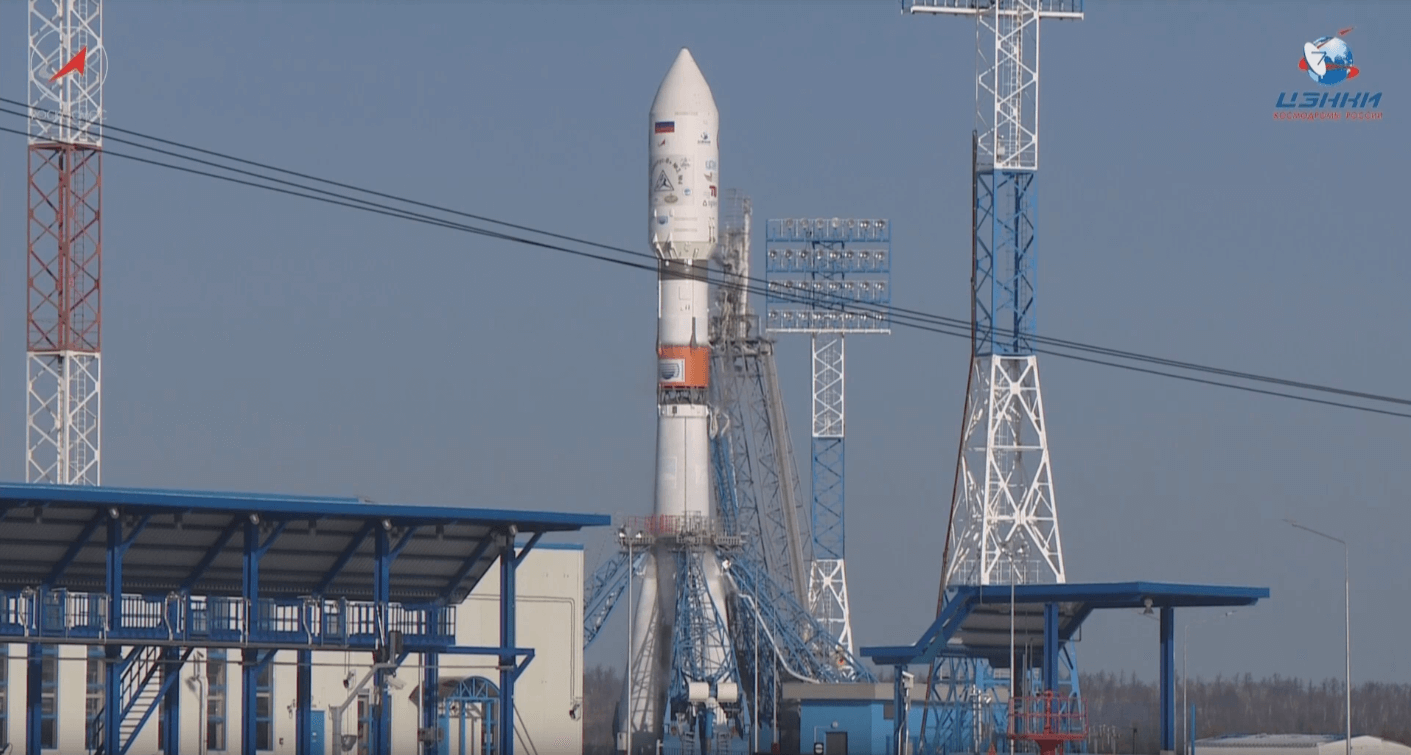
Launch facts
| Rocket | Soyuz 2.1a/Fregat-M |
| Operator | Russian Space Forces |
| Pad | 43/3 (43L), Plesetsk Cosmodrome, Russian Federation |
| T-0 (UTC) | 3 April 2026 at 06:28 |
| Status | Success |
What just launched?
A Soyuz 2.1a rocket with a Fregat-M upper stage successfully launched the Meridian-M No.21L military communications satellite from Plesetsk Cosmodrome on 3 April 2026 at 06:28 UTC. The mission, operated by the Russian Space Forces, lifted off from Site 43/3 (Pad 43L) and was declared a success.
Meridian-M is a series of Russian dual-use communications satellites placed into a highly elliptical Molniya-type orbit. They relay communications between ground stations and ships, aircraft, and remote installations across Russia's high-latitude and Arctic regions, while also serving military command-and-control needs.
Did the launch succeed?
Yes. According to the Russian Ministry of Defence's standard mission profile, the three-stage Soyuz 2.1a delivered the Fregat-M and its payload onto a suborbital trajectory, after which the Fregat-M upper stage performed the burns required to insert Meridian-M No.21L into its target Molniya orbit. The launch status is confirmed as Success.
Key mission facts
| Parameter | Detail |
|---|---|
| Rocket | Soyuz 2.1a / Fregat-M |
| Payload | Meridian-M No.21L |
| Operator | Russian Space Forces |
| Launch site | Site 43/3 (43L), Plesetsk Cosmodrome |
| Launch time | 3 April 2026, 06:28 UTC |
| Target orbit | Molniya (highly elliptical) |
| Result | Success |
What is the Soyuz 2.1a/Fregat-M?
The Soyuz 2.1a is a modernized variant of the venerable R-7-derived Soyuz family, the most-flown orbital rocket in history with several thousand launches since 1957. The 2.1a version replaced the older analog flight-control system with a digital one, improving guidance accuracy and allowing larger payload fairings. Standing roughly 46 metres tall, it uses a central core surrounded by four strap-on boosters, all burning kerosene and liquid oxygen.
The Fregat-M is a restartable upper stage that uses storable hypergolic propellants. Its ability to reignite multiple times makes it ideal for reaching demanding orbits such as the Molniya profile used by Meridian-M, which requires precise apogee placement over the Northern Hemisphere.
What is the Meridian-M payload?
Meridian-M satellites operate in a Molniya orbit inclined near 63 degrees, with a low perigee of a few hundred kilometres and an apogee close to 40,000 kilometres. This orbit keeps each satellite over Russia's northern territories for the majority of every roughly 12-hour period, providing long-duration coverage that geostationary satellites cannot deliver at extreme latitudes.
The Meridian program replaced the older Molniya-1 and Molniya-3 communications satellites. Each spacecraft supports both civilian maritime and aviation communications along the Northern Sea Route and military relay functions. No.21L continues the incremental replenishment of this constellation, which is maintained with periodic launches to sustain coverage as older units are retired.
Why Plesetsk?
Plesetsk Cosmodrome, located about 800 kilometres north of Moscow, is Russia's primary military spaceport and the busiest launch site for high-inclination and polar missions. Its northern latitude makes it well suited for Molniya and Sun-synchronous orbits. Site 43/3 is one of the pads dedicated to Soyuz-family vehicles at the facility.
How to watch and track it
Russian military launches from Plesetsk are typically not broadcast live, and confirmation usually comes from the Ministry of Defence after orbital insertion. Once cataloged, Meridian-M No.21L can be followed on Cosmik's live 3D satellite map, where you can watch its distinctive Molniya orbit sweep high over the Northern Hemisphere.
For upcoming missions, see the full rocket launch schedule and the latest launch news. If you want to learn the basics of following objects in orbit, our guide on how to track satellites explains the tools involved.
Background sources
Launch data for this recap is drawn from The Space Devs Launch Library. Further background on the vehicle and site is available on Wikipedia's pages for the Soyuz-2 rocket, the Meridian satellite series, and the Plesetsk Cosmodrome.
Follow Meridian-M No.21L and every other satellite live on Cosmik. Open the 3D solar system map to watch its orbit unfold, and enable free launch alerts so you never miss the next liftoff.
Follow this mission live in 3D and get a free alert before liftoff.
Open the live map →Sources
Next launches
- Dragon CRS-2 SpX-35 — launch time & how to watch — 13 October 2026, 10:33 UTC
- Martian Moon eXplorer (MMX) — launch time & how to watch — 19 October 2026, 19:41 UTC
- Amazon Leo (LV-01) — launch time & how to watch — 29 October 2026
More launch coverage
- Minotaur IV STP-S29A Launch Recap: Success on 7 April 2026 — 7 April 2026, 11:33 UTC
- Starlink Group 17-35 Launches on Falcon 9 — 7 April 2026 Recap — 7 April 2026, 02:50 UTC
- Atlas V 551 Launches Amazon Leo (LA-05): 4 April 2026 Recap — 4 April 2026, 05:46 UTC
- Tianlong-3 Demo Flight Fails on 3 April 2026 Debut — 3 April 2026, 04:17 UTC
- Falcon 9 Starlink Group 10-58 Launch Recap: Success on 2 April 2026 — 2 April 2026, 11:55 UTC
- Artemis II Recap: SLS Block 1 Launches 4 Crew April 1, 2026 — 1 April 2026, 22:35 UTC