Atlas V 551 Launches Amazon Leo (LA-05): 4 April 2026 Recap
Published · Updated
Atlas VAmazon LeoUnited Launch AllianceULA✓ recap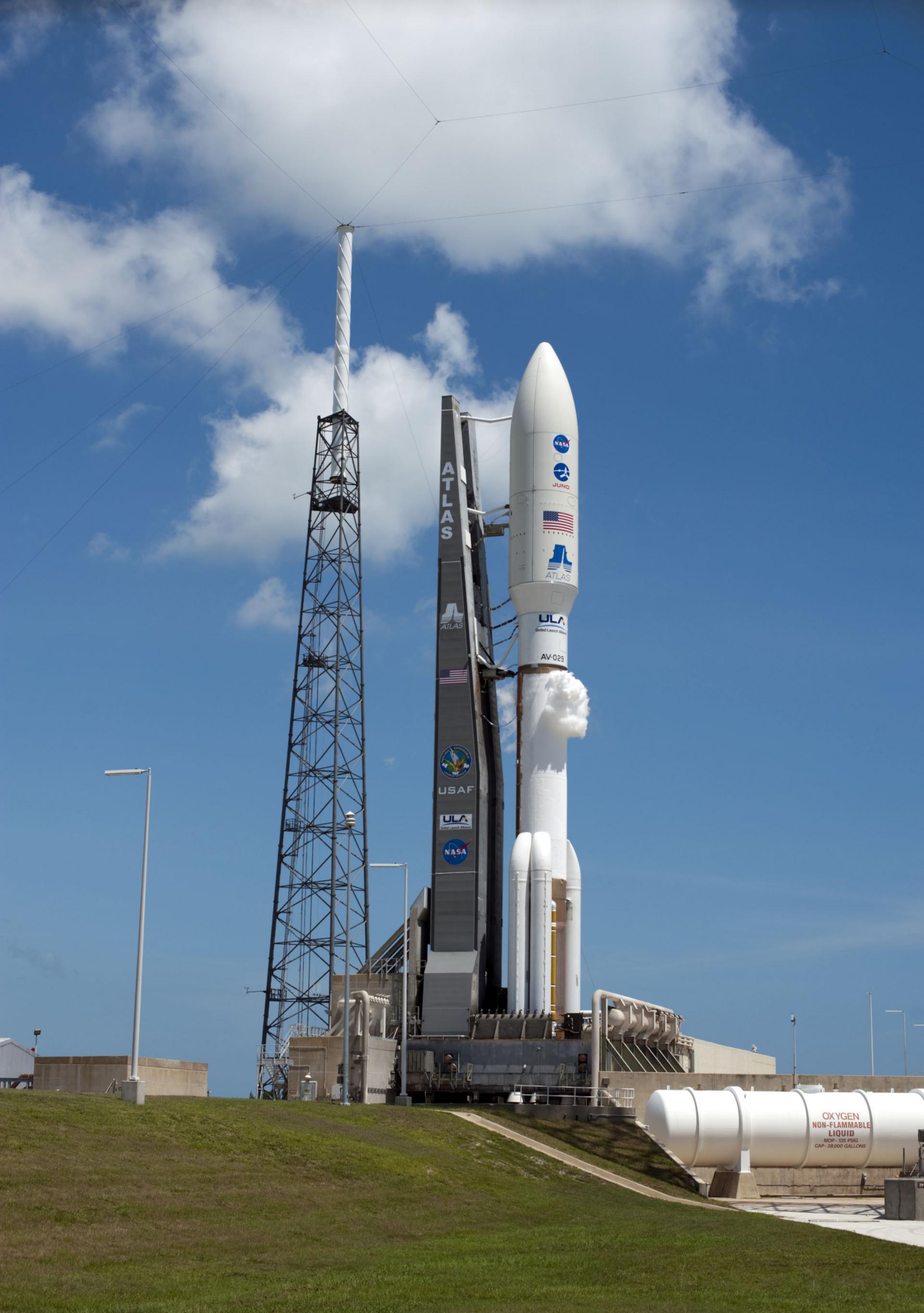
Launch facts
| Rocket | Atlas V 551 |
| Operator | United Launch Alliance |
| Pad | Space Launch Complex 41, Cape Canaveral SFS, FL, USA |
| T-0 (UTC) | 4 April 2026 at 05:46 |
| Status | Success |
What happened?
United Launch Alliance's Atlas V 551 rocket successfully launched a batch of Amazon Leo broadband satellites from Space Launch Complex 41 at Cape Canaveral Space Force Station, Florida, on 4 April 2026 at 05:46 UTC. The Atlas V 551 is the most powerful configuration in the Atlas V family, featuring a 5-meter payload fairing, five strap-on solid rocket boosters, and a single-engine Centaur upper stage.
This LA-05 mission continued the deployment of Amazon's low-Earth-orbit internet constellation, the network formerly known as Project Kuiper, which Amazon has renamed Amazon Leo. The launch was confirmed a success by United Launch Alliance.
What is the Atlas V 551?
The Atlas V 551 is the heavyweight variant of the workhorse Atlas V, a rocket that has flown since 2002. The "551" designation breaks down as follows:
- 5 — a 5-meter-diameter payload fairing
- 5 — five AJ-60A/GEM 63 solid rocket boosters
- 1 — a single RL10-powered Centaur upper stage
With all five boosters firing alongside the Russian-built RD-180 main engine, the 551 generates roughly 2.6 million pounds of thrust at liftoff, making it capable of lofting heavy payloads to a range of orbits. It is the same configuration ULA used for NASA's New Horizons and Juno interplanetary missions.
What was the payload?
The payload was a stack of Amazon Leo satellites, part of the company's planned constellation of 3,236 satellites designed to deliver low-latency broadband internet to customers worldwide. Amazon Leo operates in low Earth orbit at altitudes near 590–630 kilometers, competing directly with SpaceX's Starlink network.
Amazon holds one of the largest commercial launch procurement contracts in history, having reserved dozens of Atlas V flights alongside missions on ULA's Vulcan, Arianespace's Ariane 6, and Blue Origin's New Glenn to deploy the full constellation. Under its FCC license, Amazon must have roughly half the constellation — about 1,618 satellites — in orbit by mid-2026, making cadence missions like LA-05 critical.
Where did it launch from?
The launch used Space Launch Complex 41 (SLC-41) at Cape Canaveral Space Force Station in Florida. SLC-41 is ULA's East Coast Atlas V pad and has hosted more than 90 Atlas V launches since the rocket's debut. The pad uses a "clean pad" design where the rocket is assembled vertically in a nearby Vertical Integration Facility and rolled to the pad shortly before launch.
Launch details at a glance
| Item | Detail |
|---|---|
| Mission | Amazon Leo (LA-05) |
| Rocket | Atlas V 551 |
| Provider | United Launch Alliance |
| Launch site | SLC-41, Cape Canaveral SFS, Florida |
| Launch time | 4 April 2026, 05:46 UTC |
| Outcome | Success |
Did the launch succeed?
Yes. The mission was declared a success, with the Atlas V 551 delivering its Amazon Leo satellites toward their intended low-Earth-orbit deployment. After stage separation, the Centaur upper stage carried the payload to orbit before releasing the satellites, which will use onboard propulsion to raise themselves to their operational altitude over the following weeks.
How to track the satellites
Once the newly deployed Amazon Leo satellites are cataloged, you can follow them alongside every other object in orbit on Cosmik's live 3D satellite map. As the satellites raise their orbits, they will spread out along their orbital plane in a pattern similar to the well-known Starlink train visible in early days after deployment. Learn more about spotting them with our guide on how to track satellites.
Why does this launch matter?
Amazon Leo is one of only two large-scale commercial broadband megaconstellations under active deployment, and every Atlas V flight reduces ULA's remaining inventory of the rocket. ULA is retiring the Atlas V in favor of its next-generation Vulcan Centaur, so each 551 mission is part of a finite and dwindling flight manifest. Meeting the FCC deployment deadline requires sustained launch cadence across multiple rocket families throughout 2026.
Track upcoming missions on our rocket launch schedule, browse more launch provider hubs, and read the latest launch news. Launch data via The Space Devs Launch Library.
Sources and further reading
Follow the deployed Amazon Leo satellites live on Cosmik and enable free launch alerts so you never miss the next Atlas V or Amazon Leo mission. Watch it all unfold on our real-time 3D map at gocosmik.com.
Follow this mission live in 3D and get a free alert before liftoff.
Open the live map →Sources
Next launches
- Dragon CRS-2 SpX-35 — launch time & how to watch — 13 October 2026, 10:33 UTC
- Martian Moon eXplorer (MMX) — launch time & how to watch — 19 October 2026, 19:41 UTC
- Amazon Leo (LV-01) — launch time & how to watch — 29 October 2026
More launch coverage
- Long March 8 Launches SpaceSail Polar Group #7 — 7 April 2026 — 7 April 2026, 13:32 UTC
- Minotaur IV STP-S29A Launch Recap: Success on 7 April 2026 — 7 April 2026, 11:33 UTC
- Starlink Group 17-35 Launches on Falcon 9 — 7 April 2026 Recap — 7 April 2026, 02:50 UTC
- Soyuz 2.1a/Fregat-M Launches Meridian-M No.21L — 3 April 2026 Recap — 3 April 2026, 06:28 UTC
- Tianlong-3 Demo Flight Fails on 3 April 2026 Debut — 3 April 2026, 04:17 UTC
- Falcon 9 Starlink Group 10-58 Launch Recap: Success on 2 April 2026 — 2 April 2026, 11:55 UTC