Artemis II Recap: SLS Block 1 Launches 4 Crew April 1, 2026
Published · Updated
Artemis IISLSNASAOrion✓ recap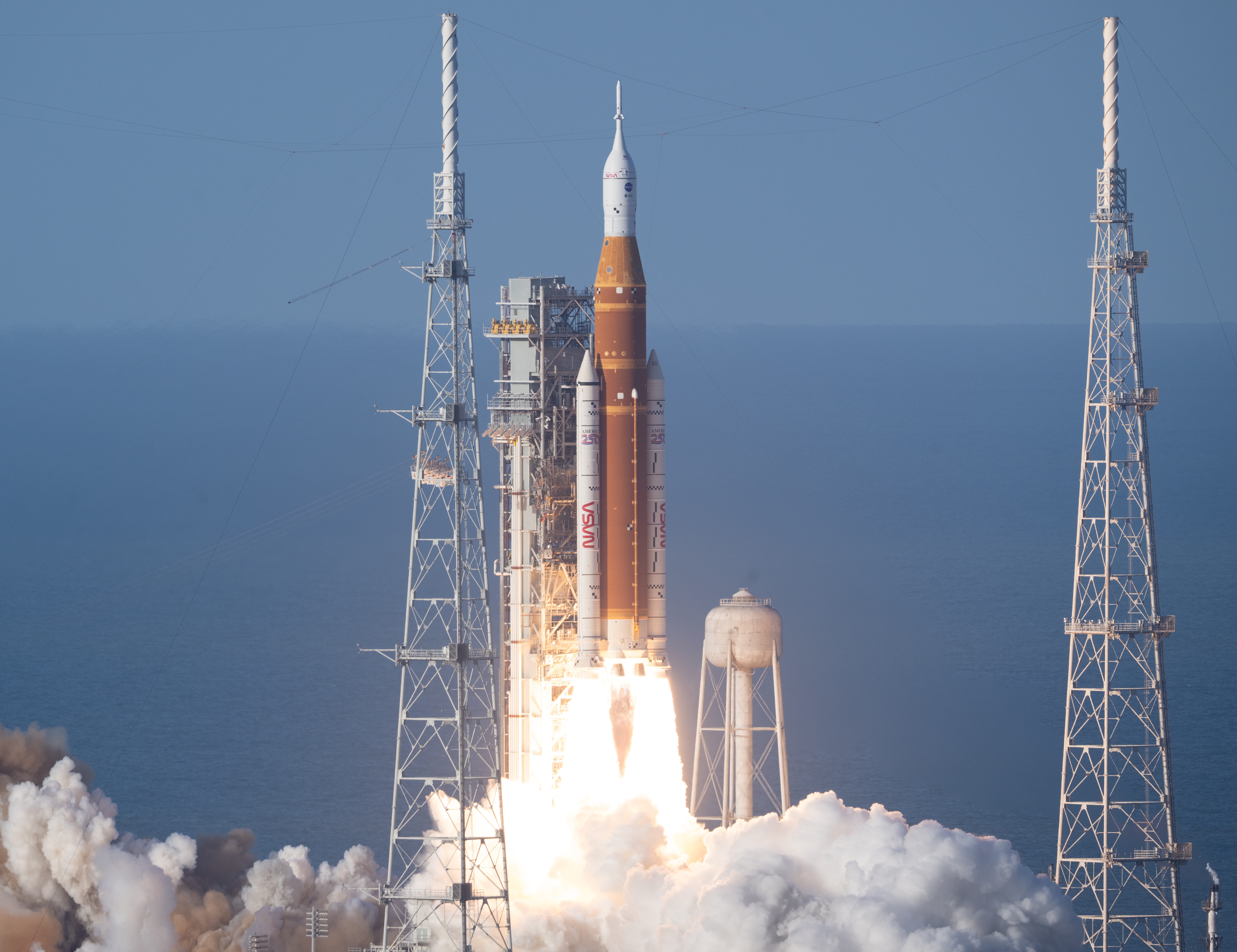
Launch facts
| Rocket | SLS Block 1 |
| Operator | National Aeronautics and Space Administration |
| Pad | Launch Complex 39B, Kennedy Space Center, FL, USA |
| T-0 (UTC) | 1 April 2026 at 22:35 |
| Status | Success |
What happened?
NASA's Artemis II mission launched successfully on 1 April 2026 at 22:35 UTC aboard an SLS Block 1 rocket from Launch Complex 39B at Kennedy Space Center, Florida. Artemis II is the first crewed flight of NASA's Artemis program, carrying four astronauts on a free-return flyby of the Moon inside the Orion spacecraft.
The Space Launch System (SLS) Block 1 is NASA's super-heavy-lift rocket, standing roughly 98 meters tall and generating about 39 meganewtons (8.8 million pounds) of thrust at liftoff — making it the most powerful rocket NASA has flown since the Saturn V. According to NASA, this was the second flight of the SLS vehicle, following the uncrewed Artemis I test in 2022.
Did the launch succeed?
Yes. NASA confirmed the launch reached a Success status. The twin five-segment solid rocket boosters and four RS-25 core-stage engines carried the vehicle through first-stage flight, after which the Interim Cryogenic Propulsion Stage (ICPS) placed Orion and its crew into an initial high-apogee Earth orbit ahead of the trans-lunar phase.
Who is on board?
Artemis II carries a crew of four astronauts — the first humans to travel toward the Moon since Apollo 17 in 1972. Per NASA's mission overview, the flight profile is a lunar free-return trajectory: Orion swings around the far side of the Moon and uses lunar gravity to loop back to Earth without entering lunar orbit, validating the spacecraft's life-support, navigation, and communications systems with crew aboard.
What is the mission duration?
The Artemis II flight is planned to last approximately 10 days, taking the crew out to a distance of several hundred thousand kilometers from Earth before returning for a splashdown in the Pacific Ocean, recovered by NASA and U.S. Navy teams.
What is the payload?
The payload is the Orion crew module and service module. Orion is NASA's deep-space crew vehicle, built by Lockheed Martin, with a European Service Module provided by the European Space Agency and Airbus that supplies propulsion, power, water, and oxygen. The service module's four solar array wings span about 19 meters when deployed and generate the electricity Orion needs for its journey.
Why does Artemis II matter?
Artemis II is the critical crewed shakedown flight before Artemis III, which aims to land astronauts near the lunar south pole. By flying real crew on a circumlunar path, NASA verifies the systems that Apollo never tested in exactly this configuration, including Orion's manual piloting, docking-approach demonstrations, and deep-space communications through the Deep Space Network.
Where did it launch from?
The rocket lifted off from Launch Complex 39B at Kennedy Space Center — the same pad complex that supported Apollo Saturn V and Space Shuttle launches. Explore more launches from the region on our Cape Canaveral and Kennedy launch hub, and see NASA's full manifest on the NASA launch page.
Launch at a glance
| Item | Detail |
|---|---|
| Mission | Artemis II |
| Rocket | SLS Block 1 |
| Operator | NASA |
| Launch date/time | 1 April 2026, 22:35 UTC |
| Pad | LC-39B, Kennedy Space Center, FL |
| Crew | 4 astronauts |
| Trajectory | Lunar free-return flyby |
| Status | Success |
How to watch live and track Orion
NASA broadcast the launch and continues to provide mission coverage on its official channels. You can follow Orion's trajectory and every other object in space on the Cosmik live 3D solar system and satellite map, and keep up with mission milestones on our latest launch news feed. Curious how orbital tracking works? See our guide on how to track satellites.
Background: the Artemis program
Artemis is NASA's program to return humans to the Moon and establish a sustainable presence there. It follows the uncrewed Artemis I in 2022 and precedes the planned Artemis III crewed landing. Learn more via Artemis II on Wikipedia, the Space Launch System, and Kennedy Space Center. Launch data is sourced from The Space Devs Launch Library.
Follow Artemis II and Orion live on Cosmik — watch the mission in 3D, browse the full rocket launch schedule, and enable free launch alerts so you never miss a liftoff.
Follow this mission live in 3D and get a free alert before liftoff.
Open the live map →Sources
Next launches
- Dragon CRS-2 SpX-35 — launch time & how to watch — 13 October 2026, 10:33 UTC
- Martian Moon eXplorer (MMX) — launch time & how to watch — 19 October 2026, 19:41 UTC
- Amazon Leo (LV-01) — launch time & how to watch — 29 October 2026
More launch coverage
- Soyuz 2.1a/Fregat-M Launches Meridian-M No.21L — 3 April 2026 Recap — 3 April 2026, 06:28 UTC
- Tianlong-3 Demo Flight Fails on 3 April 2026 Debut — 3 April 2026, 04:17 UTC
- Falcon 9 Starlink Group 10-58 Launch Recap: Success on 2 April 2026 — 2 April 2026, 11:55 UTC
- Starlink Group 10-44: Falcon 9 Launch Recap (30 March 2026) — 30 March 2026, 21:15 UTC
- Falcon 9 Transporter-16 Rideshare: Launch Recap (30 March 2026) — 30 March 2026, 11:02 UTC
- Kinetica 2 Debut: First Flight Success on 30 March 2026 — 30 March 2026, 11:00 UTC