New Glenn Fails Carrying BlueBird Block 2 — 19 April 2026 Recap
Published · Updated
New GlennBlue OriginBlueBird Block 2AST SpaceMobile✓ recap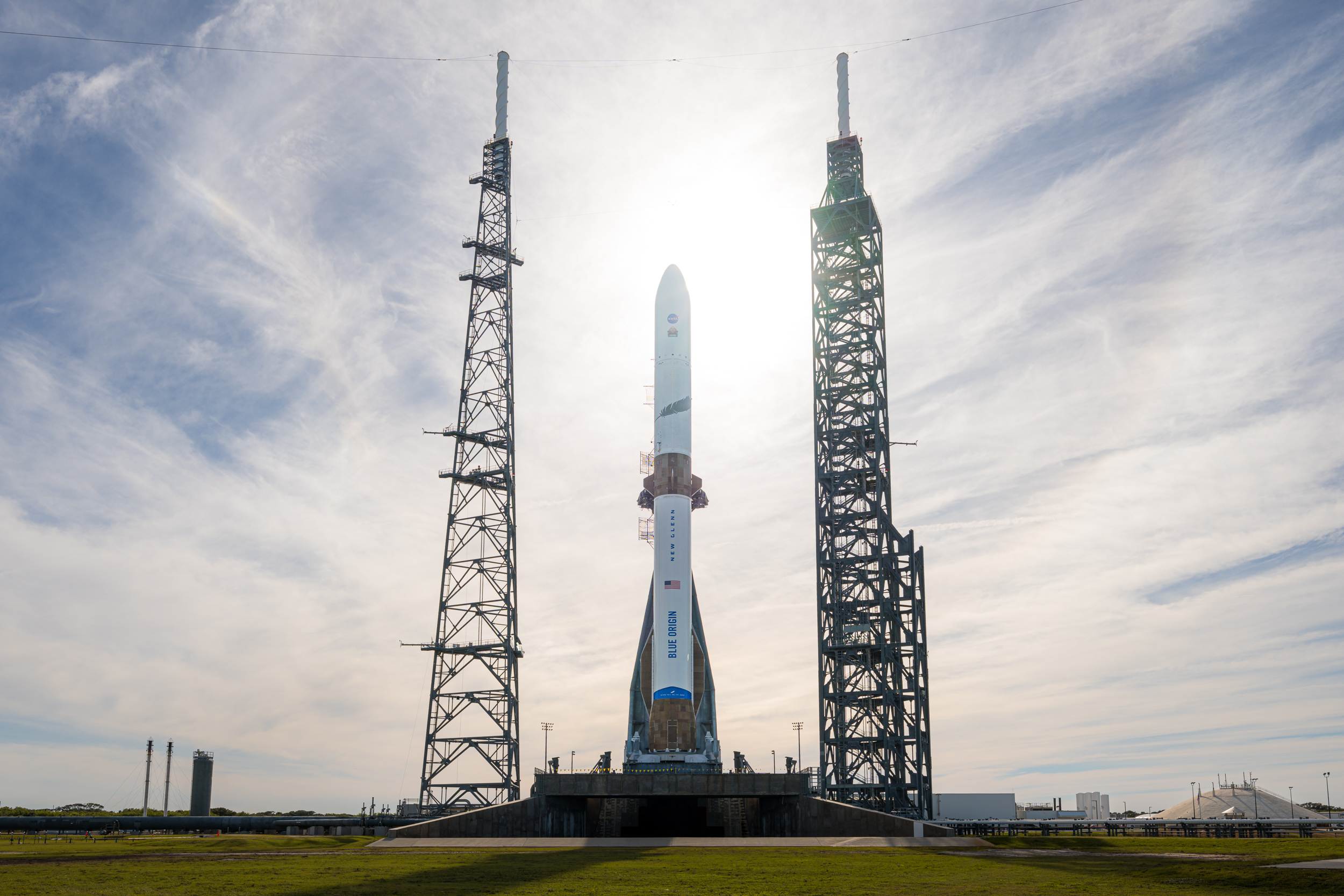
Launch facts
| Rocket | New Glenn |
| Operator | Blue Origin |
| Pad | Launch Complex 36A, Cape Canaveral SFS, FL, USA |
| T-0 (UTC) | 19 April 2026 at 11:25 |
| Status | Failure |
What happened?
Blue Origin's New Glenn rocket failed during its mission carrying BlueBird Block 2 satellites after lifting off at 11:25 UTC on 19 April 2026 from Launch Complex 36A at Cape Canaveral Space Force Station, Florida. The mission ended in failure, and the BlueBird Block 2 payloads were not successfully delivered to their intended orbit.
New Glenn is Blue Origin's heavy-lift, partially reusable orbital rocket, standing roughly 98 meters tall with a 7-meter payload fairing — one of the largest fairings in operation. It is designed to launch large satellites, constellations, and eventually crewed missions, with a reusable first stage intended to land on a downrange sea-based platform.
What was the payload?
The payload was a batch of BlueBird Block 2 satellites, part of AST SpaceMobile's direct-to-cell broadband constellation. BlueBird satellites are notable for their enormous phased-array antennas — the Block 2 design carries an aperture on the order of hundreds of square meters — enabling standard, unmodified smartphones to connect directly to the spacecraft from anywhere with a clear view of the sky.
AST SpaceMobile's constellation is intended to grow to dozens of operational satellites in low Earth orbit to provide continuous cellular coverage. The loss of this batch is a setback for the constellation's near-term deployment timeline.
Did the launch succeed?
No. According to the launch status, the mission is classified as a Failure. This was the second flight of the BlueBird Block 2 configuration on New Glenn. Blue Origin and AST SpaceMobile are expected to conduct a formal investigation into the anomaly before New Glenn returns to flight.
Failures early in a new heavy-lift vehicle's operational life are not unusual. New rocket programs frequently encounter setbacks as their systems are wrung out under real flight conditions, and detailed anomaly reviews typically follow to identify and correct the root cause.
Launch details at a glance
| Item | Detail |
|---|---|
| Rocket | New Glenn |
| Provider | Blue Origin |
| Payload | BlueBird Block 2 (AST SpaceMobile) |
| Launch site | Launch Complex 36A, Cape Canaveral SFS, Florida |
| Liftoff | 19 April 2026, 11:25 UTC |
| Outcome | Failure |
Where did it launch from?
The mission flew from Launch Complex 36 (LC-36) at Cape Canaveral Space Force Station. Blue Origin refurbished the historic pad — which supported Atlas missions in the mid-20th century — as its dedicated New Glenn launch site on the Space Coast. The location on Florida's east coast provides efficient access to a range of orbital inclinations for low Earth orbit constellations.
What is New Glenn?
New Glenn is powered by seven BE-4 engines on its reusable first stage, the same methane-fueled engine that also powers United Launch Alliance's Vulcan rocket. The vehicle is designed to place large payloads into low Earth orbit and beyond, with Blue Origin targeting first-stage recovery and reuse to lower long-term launch costs.
The rocket is named after astronaut John Glenn, the first American to orbit the Earth. You can follow Blue Origin's upcoming attempts and other missions on our launch provider hubs and the full rocket launch schedule.
What happens next?
Following any launch failure, the standard process involves grounding the vehicle pending an investigation, identifying corrective actions, and coordinating with regulators before the next flight. AST SpaceMobile will assess the impact on its constellation buildout and may adjust its manifest across available launch providers.
For readers tracking the direct-to-cell race, the BlueBird constellation competes with other space-based cellular efforts and depends on regular, reliable launches to reach continuous global coverage.
How to follow future launches
You can watch every upcoming mission unfold on Cosmik's real-time tools. Explore our live 3D map of the solar system and every satellite in orbit, browse the Cape Canaveral launch schedule, and read the latest launch news. Launch data is sourced from The Space Devs Launch Library.
Background references: New Glenn (Wikipedia), Blue Origin (Wikipedia), and Cape Canaveral SFS (Wikipedia).
Follow it live on Cosmik
Don't miss New Glenn's return to flight or the next BlueBird deployment. Track rockets and satellites in real time on Cosmik's free 3D map and turn on free launch alerts so you're notified before the next liftoff.
Follow this mission live in 3D and get a free alert before liftoff.
Open the live map →Sources
Next launches
- Dragon CRS-2 SpX-35 — launch time & how to watch — 13 October 2026, 10:33 UTC
- Martian Moon eXplorer (MMX) — launch time & how to watch — 19 October 2026, 19:41 UTC
- Amazon Leo (LV-01) — launch time & how to watch — 29 October 2026
More launch coverage
- Rocket Lab HASTE 'Bubbles' Launch Recap — 22 April 2026 — 22 April 2026, 01:36 UTC
- Falcon 9 Launches GPS III SV10 — Recap of 21 April 2026 Flight — 21 April 2026, 06:53 UTC
- Falcon 9 Starlink Group 17-22: Launch Success on 19 April 2026 — 19 April 2026, 16:03 UTC
- Long March 4C Launches Daqi-2 (AEMS): 17 April 2026 Recap — 17 April 2026, 04:10 UTC
- Soyuz 2.1b/Volga Kosmos Launch Recap: Success on 16 April 2026 — 16 April 2026, 23:17 UTC
- Falcon 9 Starlink Group 17-27: Launch Success (April 15, 2026) — 15 April 2026, 04:29 UTC