Soyuz 2.1b/Volga Kosmos Launch Recap: Success on 16 April 2026
Published · Updated
Soyuz 2.1bVolga upper stageKosmosRussian Space Forces✓ recap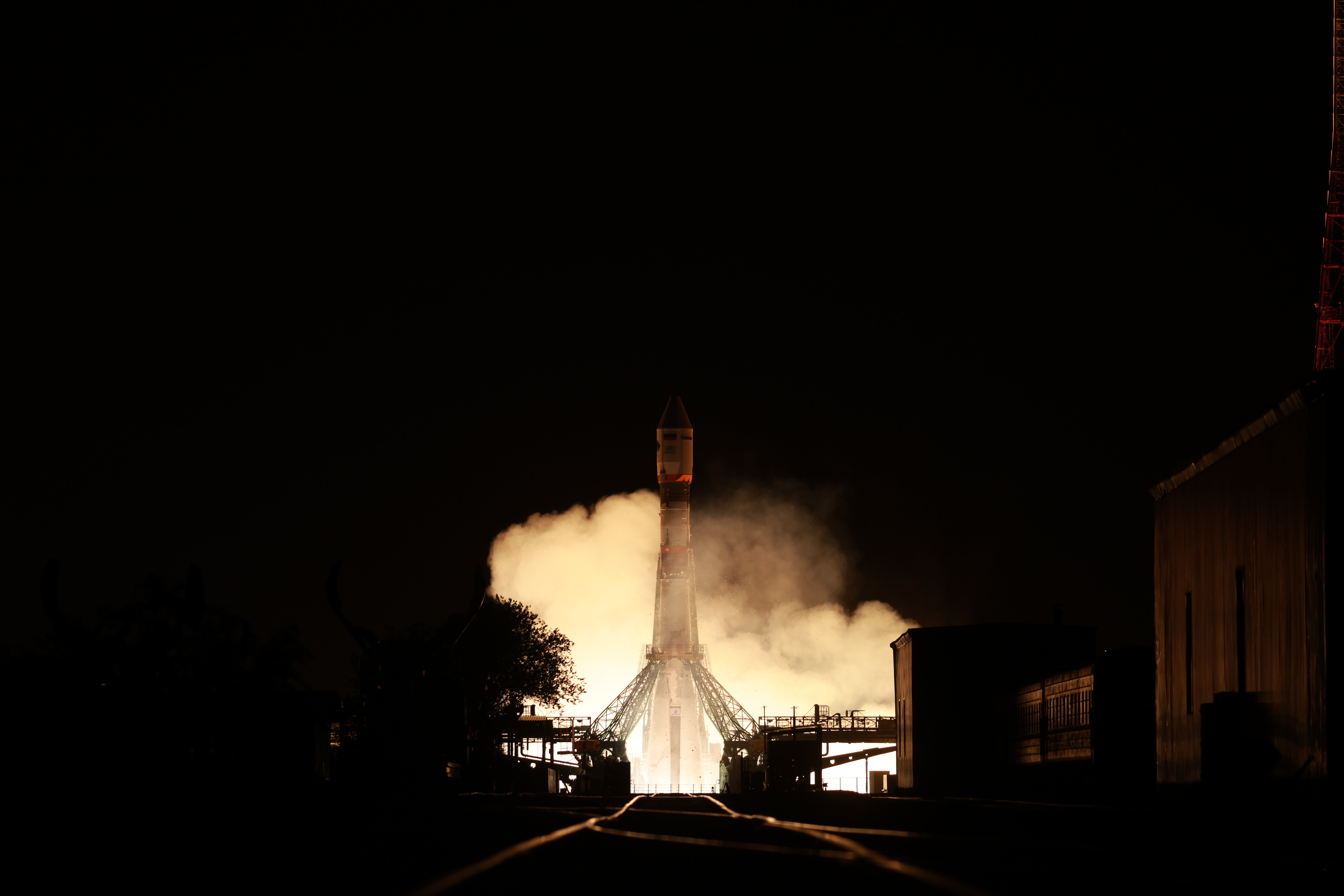
Launch facts
| Rocket | Soyuz 2.1b/Volga |
| Operator | Russian Space Forces |
| Pad | 43/4 (43R), Plesetsk Cosmodrome, Russian Federation |
| T-0 (UTC) | 16 April 2026 at 23:17 |
| Status | Success |
What just launched?
A Soyuz 2.1b/Volga rocket successfully launched a classified Kosmos military payload from the Plesetsk Cosmodrome in northern Russia on 16 April 2026 at 23:17 UTC. The Soyuz 2.1b is a modernized three-stage version of the legendary R-7-derived Soyuz family, fitted with a digital flight control system and an upgraded RD-0124 third-stage engine, while the Volga upper stage acts as an orbital tug to place payloads into precise final orbits.
Did the launch succeed?
Yes. The mission was declared a success by the operator, the Russian Space Forces (Vozdushno-Kosmicheskie Sily). The payload was assigned a Kosmos designation, the standard naming convention Russia uses for military and classified spacecraft. Specific details of the satellite's mass, orbit, and purpose have not been disclosed, consistent with the secrecy that surrounds most Kosmos-series launches.
Key mission facts
| Detail | Value |
|---|---|
| Rocket | Soyuz 2.1b/Volga |
| Payload | Kosmos (classified) |
| Operator | Russian Space Forces |
| Launch date/time | 16 April 2026, 23:17 UTC |
| Launch site | Pad 43/4 (43R), Plesetsk Cosmodrome |
| Result | Success |
Where did it launch from?
The launch took place from Site 43/4 (Pad 43R) at the Plesetsk Cosmodrome, located roughly 800 kilometers north of Moscow in Arkhangelsk Oblast. Plesetsk is the world's northernmost orbital launch site and is used almost exclusively for Russian military and government missions. Its high latitude of about 63 degrees North makes it especially well suited to launches into high-inclination and polar orbits, which are commonly used for reconnaissance, navigation, and early-warning spacecraft.
What is the Soyuz 2.1b/Volga?
The Soyuz 2.1b is the most capable member of the Soyuz-2 family, a design lineage that traces back to Sergei Korolev's R-7 rocket of the 1950s — the same basic architecture that launched Sputnik 1. The 2.1b variant introduced a new third-stage engine and digital guidance, improving payload performance to low Earth orbit to roughly 8,200 kilograms depending on trajectory.
The Volga upper stage is a compact, restartable orbital transfer module developed to extend the Soyuz-2's reach. It performs one or more burns after separation to circularize orbits or adjust inclination, allowing payloads to be delivered to a precise operational altitude before the stage is deorbited or left in a disposal orbit. This combination is frequently used for Russian defense-related deployments where exact orbital placement matters.
Why the Kosmos name?
Since 1962, the Kosmos designation has been applied to well over 2,500 Soviet and Russian satellites spanning military reconnaissance, communications, navigation, technology demonstration, and scientific research. Because the specific function is not published, observers typically infer a payload's role from its orbital parameters once tracking data becomes available from independent sources.
How to track the payload
Once cataloged, the newly deployed spacecraft can be followed alongside thousands of other objects in orbit. You can watch it move in real time on Cosmik's live 3D solar-system and satellite map, and learn the fundamentals on our guide to tracking satellites. For upcoming Russian and global missions, see the full rocket launch schedule.
What's next from Plesetsk?
Plesetsk maintains a steady cadence of Soyuz-2 and Angara launches supporting Russia's military space program. Each mission adds to the growing population of tracked objects in low and medium Earth orbit. For the latest coverage of this and other launches, visit Cosmik's launch news.
Background sources
Launch data for this recap is drawn from The Space Devs Launch Library. Additional background on the vehicle and facility is available via Wikipedia:
Follow the mission live on Cosmik
Track the Kosmos payload and every other satellite in orbit on Cosmik's free live 3D map, and enable free launch alerts so you never miss the next Soyuz, Angara, or global mission lift-off.
Follow this mission live in 3D and get a free alert before liftoff.
Open the live map →Sources
Next launches
- Dragon CRS-2 SpX-35 — launch time & how to watch — 13 October 2026, 10:33 UTC
- Martian Moon eXplorer (MMX) — launch time & how to watch — 19 October 2026, 19:41 UTC
- Amazon Leo (LV-01) — launch time & how to watch — 29 October 2026
More launch coverage
- Falcon 9 Starlink Group 17-22: Launch Success on 19 April 2026 — 19 April 2026, 16:03 UTC
- New Glenn Fails Carrying BlueBird Block 2 — 19 April 2026 Recap — 19 April 2026, 11:25 UTC
- Long March 4C Launches Daqi-2 (AEMS): 17 April 2026 Recap — 17 April 2026, 04:10 UTC
- Falcon 9 Starlink Group 17-27: Launch Success (April 15, 2026) — 15 April 2026, 04:29 UTC
- Starlink Group 10-24: Falcon 9 Launch Recap (14 Apr 2026) — 14 April 2026, 09:33 UTC
- Kinetica 1 Launches 8 Jilin-1 Satellites — 14 April 2026 Recap — 14 April 2026, 04:03 UTC