Long March 4C Launches Daqi-2 (AEMS): 17 April 2026 Recap
Published · Updated
Long March 4CDaqi-2AEMSCASC✓ recap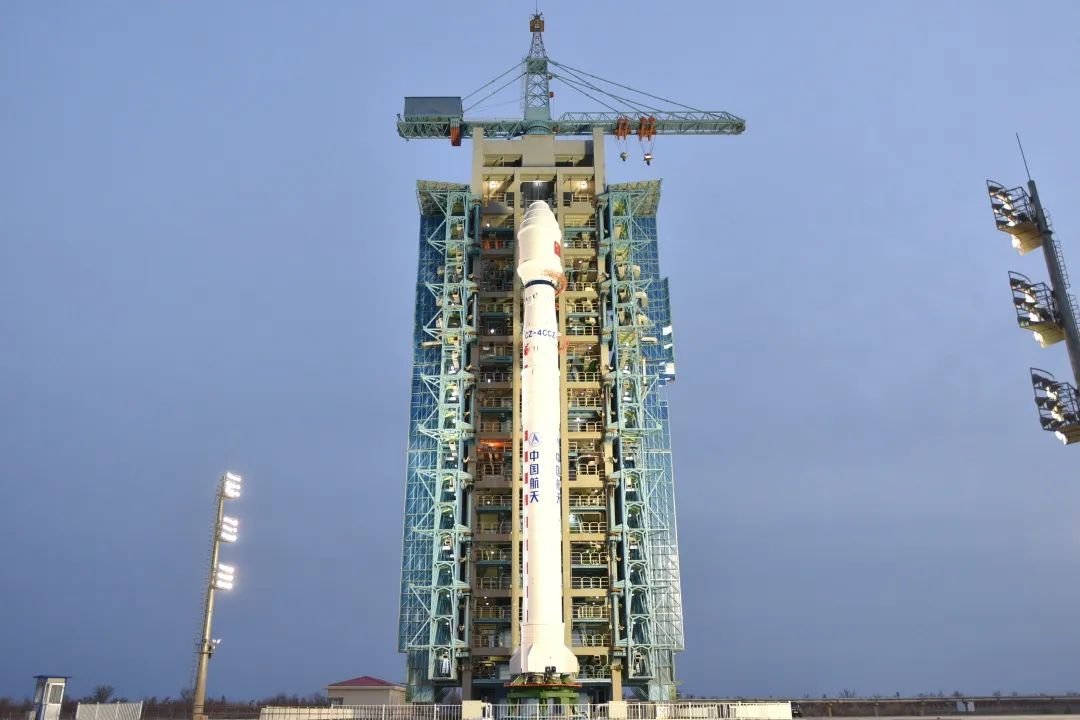
Launch facts
| Rocket | Long March 4C |
| Operator | China Aerospace Science and Technology Corporation |
| Pad | Launch Area 94 (SLS-2 / 603), Jiuquan Satellite Launch Center, People's Republic of China |
| T-0 (UTC) | 17 April 2026 at 04:10 |
| Status | Success |
What launched and did it succeed?
China successfully launched the Daqi-2 (AEMS) atmospheric environment monitoring satellite aboard a Long March 4C rocket on 17 April 2026 at 04:10 UTC from Launch Area 94 (SLS-2) at the Jiuquan Satellite Launch Center. The mission was declared a success by the China Aerospace Science and Technology Corporation (CASC).
The Long March 4C is a three-stage, liquid-fueled orbital rocket built by CASC, primarily used to deliver Earth-observation and meteorological payloads into Sun-synchronous orbits. Daqi-2 — its name meaning "atmosphere" in Chinese — is a dedicated greenhouse-gas and air-quality monitoring spacecraft.
When did the launch happen?
| Detail | Value |
|---|---|
| Rocket | Long March 4C |
| Payload | Daqi-2 (AEMS) |
| Date & time | 17 April 2026, 04:10 UTC |
| Pad | Launch Area 94 (SLS-2 / 603), Jiuquan |
| Provider | CASC |
| Result | Success |
What is the payload?
Daqi-2 (AEMS, Atmospheric Environment Monitoring Satellite) is designed to measure atmospheric carbon dioxide, aerosols, and fine-particulate pollution across China and beyond. It builds on the first-generation Daqi-1 mission, extending China's capacity to track greenhouse-gas concentrations and air quality with high spatial resolution.
Satellites of this class typically fly in a Sun-synchronous orbit near 700 km altitude, an orbit chosen so the spacecraft crosses each point on Earth at the same local solar time — ideal for consistent atmospheric imaging. The instruments carried by such platforms combine hyperspectral cloud-and-aerosol detectors with LiDAR-type sensors for vertical profiling.
What is the Long March 4C?
The Long March 4C is one of the workhorses of China's launch fleet, a three-stage vehicle standing roughly 46 metres tall and capable of placing around 3 tonnes into a 700 km Sun-synchronous orbit. It burns storable hypergolic propellants (nitrogen tetroxide and unsymmetrical dimethylhydrazine) across all three stages, giving it the flexibility to launch on demand from multiple inland spaceports.
First flown in 2006, the Long March 4C has become a reliable platform for reconnaissance, weather, and Earth-science satellites. Jiuquan, in the Gobi Desert of Inner Mongolia, is China's oldest and most-used launch complex and the only site currently supporting crewed spaceflight.
Why this mission matters
Daqi-2 strengthens China's environmental-monitoring constellation at a time when independent, satellite-based greenhouse-gas measurement is increasingly central to global climate accounting. Continuous data from dedicated atmospheric satellites help verify emissions inventories and track pollution episodes in near real time.
How to watch and track the mission
Chinese state launches are typically confirmed shortly after liftoff rather than carried live, and success for this flight was reported by CASC. While the launch itself has concluded, you can now follow Daqi-2 and thousands of other operational spacecraft as they orbit Earth.
- See the newly deployed satellite's orbit on the Cosmik live 3D satellite map.
- Browse upcoming missions on the rocket launch schedule.
- Read more coverage in the latest launch news.
- Learn the basics with our guide to tracking satellites.
Key facts at a glance
- Vehicle: Long March 4C, a three-stage hypergolic rocket standing about 46 m tall.
- Orbit class: Sun-synchronous, typically near 700 km altitude for this satellite type.
- Operator: China Aerospace Science and Technology Corporation, the primary contractor for China's Long March family.
- Launch site: Jiuquan Satellite Launch Center, operational since 1958.
Sources and further reading
Launch data is drawn from The Space Devs Launch Library. Background on the vehicle, operator, and spaceport is available via Long March 4C, CASC, and the Jiuquan Satellite Launch Center.
Follow Daqi-2 and every satellite in orbit live on Cosmik's 3D solar-system map, and enable free launch alerts on our launch tracker so you never miss the next liftoff.
Follow this mission live in 3D and get a free alert before liftoff.
Open the live map →Sources
Next launches
- Dragon CRS-2 SpX-35 — launch time & how to watch — 13 October 2026, 10:33 UTC
- Martian Moon eXplorer (MMX) — launch time & how to watch — 19 October 2026, 19:41 UTC
- Amazon Leo (LV-01) — launch time & how to watch — 29 October 2026
More launch coverage
- Falcon 9 Launches GPS III SV10 — Recap of 21 April 2026 Flight — 21 April 2026, 06:53 UTC
- Falcon 9 Starlink Group 17-22: Launch Success on 19 April 2026 — 19 April 2026, 16:03 UTC
- New Glenn Fails Carrying BlueBird Block 2 — 19 April 2026 Recap — 19 April 2026, 11:25 UTC
- Soyuz 2.1b/Volga Kosmos Launch Recap: Success on 16 April 2026 — 16 April 2026, 23:17 UTC
- Falcon 9 Starlink Group 17-27: Launch Success (April 15, 2026) — 15 April 2026, 04:29 UTC
- Starlink Group 10-24: Falcon 9 Launch Recap (14 Apr 2026) — 14 April 2026, 09:33 UTC