Long March 8A Launches SpaceSail Polar #14 — July 5, 2026
Published · Updated
Long March 8ASpaceSailQianfanCASC✓ recap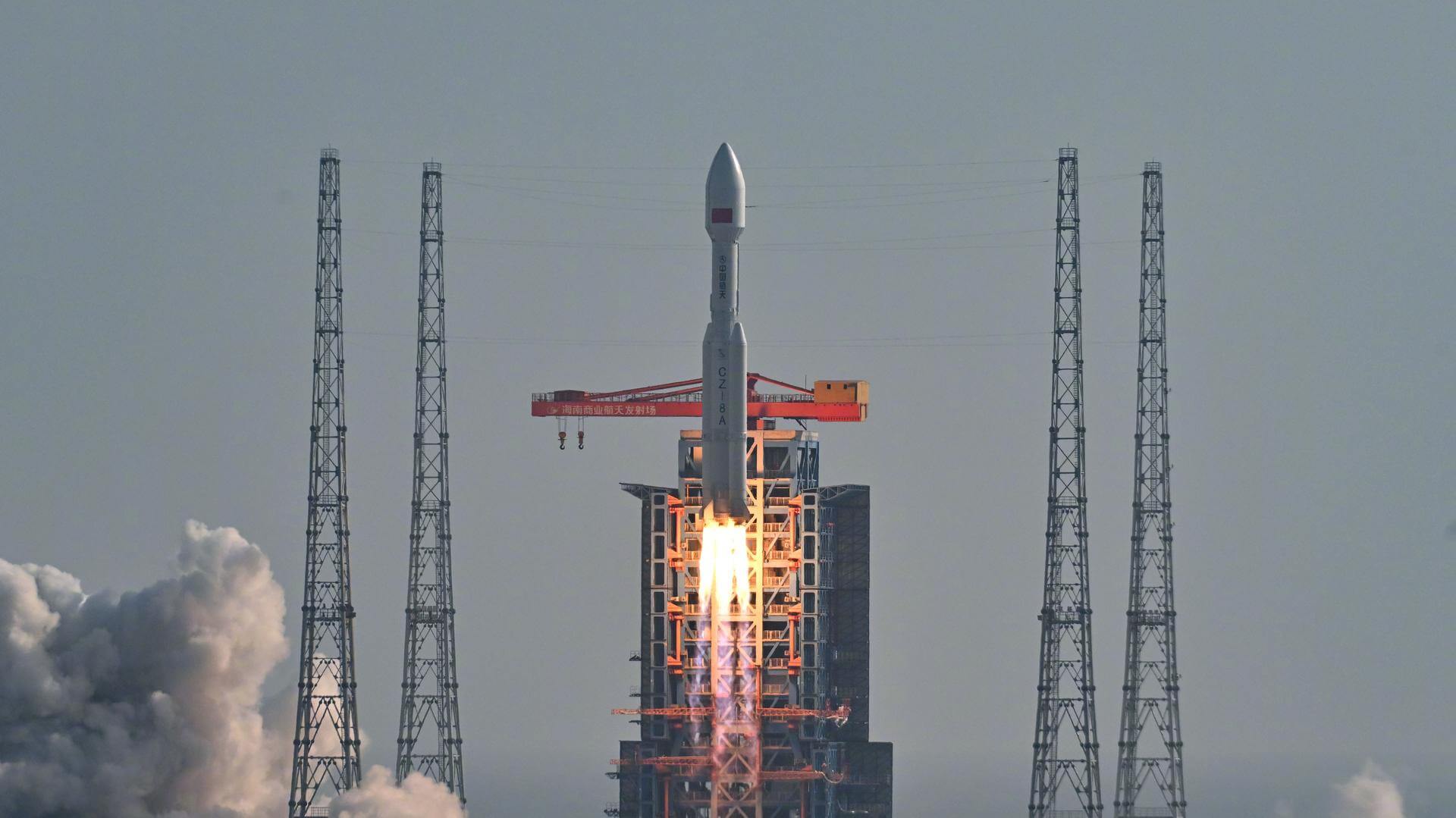
Launch facts
| Rocket | Long March 8A |
| Operator | China Aerospace Science and Technology Corporation |
| Pad | Commercial LC-1, Wenchang Space Launch Site, People's Republic of China |
| T-0 (UTC) | 5 July 2026 at 13:43 |
| Status | Success |
A Long March 8A rocket successfully launched the SpaceSail Polar Group #14 satellites on 5 July 2026 at 13:43 UTC from Commercial LC-1 at the Wenchang Space Launch Site, People's Republic of China. The mission, operated by the China Aerospace Science and Technology Corporation (CASC), was confirmed successful, adding another batch of broadband satellites to China's growing polar-orbit megaconstellation.
What is the Long March 8A?
The Long March 8A is a medium-lift, two-stage liquid-fueled rocket in China's Long March family, optimized for deploying satellites into low Earth and Sun-synchronous orbits. It is an upgraded variant of the Long March 8, featuring a more powerful second stage that increases its payload capacity to Sun-synchronous orbit to roughly 7 tonnes. The vehicle has become a workhorse for China's commercial constellation buildout, with its enlarged 5.2-meter fairing accommodating dense stacks of flat-panel satellites.
Did the launch succeed?
Yes. According to CASC, the launch was a success, with the satellites reaching their planned orbit. Liftoff occurred precisely at 13:43 UTC from the dedicated commercial launch complex at Wenchang, on China's tropical Hainan Island.
What is the payload?
The payload was the 14th batch of SpaceSail Polar Group satellites, part of the constellation formerly known as Qianfan ("Thousand Sails" or G60 Starlink). SpaceSail is China's answer to broadband megaconstellations, and its operator Shanghai Spacecom Satellite Technology (SSST) has publicly outlined plans for more than 15,000 satellites in low Earth orbit, with the first phase targeting around 1,300 spacecraft. The flat-panel satellites are stacked in multiples and dispensed into polar orbit to provide global coverage.
The polar-orbit batches in this series are deployed into near-polar Sun-synchronous orbits at altitudes commonly around 800 kilometers, an altitude chosen to balance coverage, latency, and constellation longevity. Each Long March 8A launch typically carries a batch of around 18 satellites for this program.
Why does this launch matter?
SpaceSail is one of three major Chinese LEO broadband projects, alongside the state-backed Guowang constellation. Frequent launches like this one are essential to meeting spectrum-filing deadlines set by the International Telecommunication Union, which require operators to deploy a defined percentage of their constellation within fixed timeframes. Every successful batch narrows the gap between China's fleet and the market-leading Starlink network.
Where did it launch from?
Wenchang Space Launch Site is China's newest and southernmost spaceport, located near the equator on Hainan Island. Its low latitude gives rockets a modest performance boost, and its coastal position allows spent stages to fall safely over water rather than inland. The Commercial LC-1 pad was built specifically to support the high launch cadence demanded by commercial constellations.
Launch at a glance
| Detail | Value |
|---|---|
| Mission | SpaceSail Polar Group #14 |
| Rocket | Long March 8A |
| Operator | CASC |
| Launch date/time | 5 July 2026, 13:43 UTC |
| Launch site | Commercial LC-1, Wenchang, China |
| Orbit | Polar / Sun-synchronous LEO |
| Result | Success |
How to watch and track it
Chinese commercial launches are frequently confirmed after the fact rather than livestreamed in full, but you can follow the freshly deployed satellites as they spread into their orbital planes. Cosmik's live 3D satellite map lets you see the constellation build out in real time, and our satellite tracking guide explains how to spot them overhead. Browse upcoming missions on the rocket launch schedule and read more coverage on our latest launch news page.
Data for this mission is sourced from The Space Devs Launch Library. Background on the launch system and site is available on Wikipedia's Long March 8 and Wenchang Space Launch Site pages, and on the Qianfan constellation article.
Follow the SpaceSail constellation live on Cosmik. Watch every satellite orbit Earth in 3D, track upcoming Long March missions, and enable free launch alerts so you never miss the next deployment.
Follow this mission live in 3D and get a free alert before liftoff.
Open the live map →Sources
Next launches
- Dragon CRS-2 SpX-35 — launch time & how to watch — 13 October 2026, 10:33 UTC
- Martian Moon eXplorer (MMX) — launch time & how to watch — 19 October 2026, 19:41 UTC
- Amazon Leo (LV-01) — launch time & how to watch — 29 October 2026
More launch coverage
- Long March 10B Demo Flight: Launch Recap for 10 July 2026 — 10 July 2026, 04:15 UTC
- Falcon 9 Starlink Group 10-42: Launch Recap (9 July 2026) — 9 July 2026, 09:25 UTC
- Falcon 9 Transporter-17 Rideshare: Launch Recap (7 July 2026) — 7 July 2026, 07:12 UTC
- Falcon 9 Starlink Group 10-50 Launch Recap — 5 July 2026 — 5 July 2026, 10:50 UTC
- Long March 6A Launches SpaceSail Polar Group #13 — 4 July 2026 Recap — 4 July 2026, 09:30 UTC
- Pegasus XL Launches Swift Boost Mission: 3 July 2026 Recap — 3 July 2026, 08:36 UTC