Atlas V 551 Launches Amazon Leo (LA-07): 29 May 2026 Recap
Published · Updated
Atlas V 551Amazon LeoProject KuiperUnited Launch Alliance✓ recap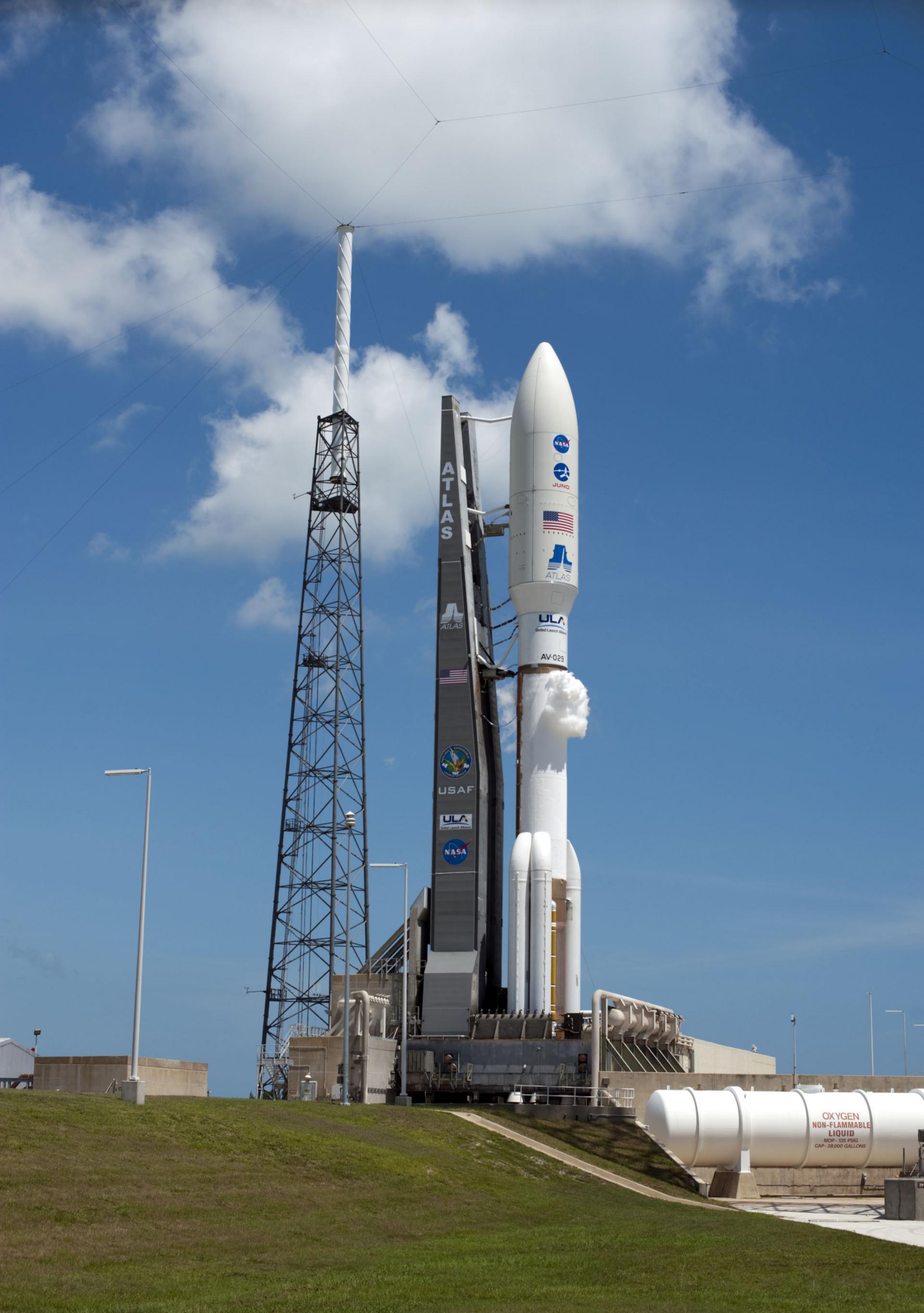
Launch facts
| Rocket | Atlas V 551 |
| Operator | United Launch Alliance |
| Pad | Space Launch Complex 41, Cape Canaveral SFS, FL, USA |
| T-0 (UTC) | 29 May 2026 at 23:53 |
| Status | Success |
What happened?
A United Launch Alliance Atlas V 551 rocket successfully launched the Amazon Leo (LA-07) mission at 23:53 UTC on 29 May 2026 from Space Launch Complex 41 at Cape Canaveral Space Force Station, Florida. The flight deployed a batch of broadband satellites for Amazon's low-Earth-orbit internet constellation, formerly known as Project Kuiper.
The Atlas V 551 is the most powerful configuration of the Atlas V family, built by United Launch Alliance. It pairs a single-core first stage with five solid rocket boosters, a 5-meter payload fairing, and a single-engine Centaur upper stage — the same variant that has flown missions including NASA's New Horizons.
Did the launch succeed?
Yes. ULA confirmed the mission status as a success. The five solid rocket boosters and the RD-180-powered first stage carried the stack through the dense lower atmosphere before the Centaur upper stage completed orbital insertion of the Amazon Leo satellites.
What is the Atlas V 551?
The "551" designation encodes the vehicle's configuration: a 5-meter fairing, 5 solid rocket boosters, and 1 Centaur engine. With all five boosters, the 551 produces roughly 2.6 million pounds of thrust at liftoff, making it the workhorse ULA has assigned to the heaviest early Amazon Leo deployments.
What is the payload?
Amazon Leo — rebranded from Project Kuiper — is Amazon's planned constellation of more than 3,200 satellites designed to deliver low-latency broadband internet to consumers, businesses, and governments worldwide. The satellites operate in low Earth orbit at altitudes of around 590 to 630 kilometers, similar in strategy to competing broadband megaconstellations.
The LA-07 designation marks this as one in a sequence of dedicated Amazon Leo launches. Amazon has contracted a large block of Atlas V flights alongside missions on other vehicles to build out the network at pace, with commercial service ramping as satellite numbers grow.
Why Atlas V for this mission?
ULA's Atlas V has one of the most reliable records in modern spaceflight, with a track record spanning well over 100 flights since its 2002 debut. Amazon reserved a set of these vehicles to accelerate early constellation deployment while its next-generation Vulcan rocket and other providers scaled up.
Launch details at a glance
| Item | Detail |
|---|---|
| Mission | Amazon Leo (LA-07) |
| Rocket | Atlas V 551 |
| Provider | United Launch Alliance |
| Launch time | 23:53 UTC, 29 May 2026 |
| Pad | SLC-41, Cape Canaveral SFS, Florida |
| Status | Success |
Where did it launch from?
The mission lifted off from Space Launch Complex 41 at Cape Canaveral Space Force Station. SLC-41 is ULA's East Coast Atlas V pad and has hosted many of the company's highest-profile science and national security missions. You can explore other flights from the site on our Cape Canaveral launch hub.
How to watch the replay
ULA streams its launches on its official broadcast channels, with coverage typically starting around 20 minutes before liftoff. Post-launch, the full webcast replay remains available for viewing, covering the countdown, ignition, booster separation, and payload deployment sequences.
Track the deployed satellites
Once cataloged, the newly launched Amazon Leo satellites can be followed as they raise their orbits and spread into their operational planes. Cosmik's live 3D solar system and satellite map lets you visualize objects in orbit in real time, and you can learn the basics on our guide to tracking satellites.
What's next?
Amazon Leo requires a sustained launch cadence across multiple rockets to reach its target of thousands of satellites. Additional Atlas V and Vulcan missions are scheduled to continue building out the constellation. See upcoming flights on the rocket launch schedule and catch the latest developments in our launch news feed. Launch data for this article is sourced from The Space Devs Launch Library.
More on the operator's flights is available on our provider hubs and across the broader launch calendar.
Follow every launch live on Cosmik
Track the Amazon Leo satellites and every rocket launch in real time on Cosmik's free 3D map, and enable free launch alerts so you never miss a liftoff — including the next Atlas V and Amazon Leo missions.
Follow this mission live in 3D and get a free alert before liftoff.
Open the live map →Sources
Next launches
- Dragon CRS-2 SpX-35 — launch time & how to watch — 13 October 2026, 10:33 UTC
- Martian Moon eXplorer (MMX) — launch time & how to watch — 19 October 2026, 19:41 UTC
- Amazon Leo (LV-01) — launch time & how to watch — 29 October 2026
More launch coverage
- Long March 12B Debut Succeeds: SpaceSail Polar Group #10 Launch Recap (1 June 2026) — 1 June 2026, 08:40 UTC
- Long March 2D Launches 4 SatNet Satellites — 30 May 2026 — 30 May 2026, 18:07 UTC
- Falcon 9 Starlink Group 17-41 Launch Recap — 30 May 2026 — 30 May 2026, 15:25 UTC
- Falcon 9 Starlink Group 10-53 Launch Recap — 29 May 2026 — 29 May 2026, 12:57 UTC
- Long March 7A Launches TJSW-24 on 26 May 2026 — Recap — 26 May 2026, 16:16 UTC
- Falcon 9 Starlink Group 17-37: Launch Succeeds 26 May 2026 — 26 May 2026, 14:50 UTC