Long March 7A Launches TJSW-24 on 26 May 2026 — Recap
Published · Updated
Long March 7ATJSW-24CASCWenchang✓ recap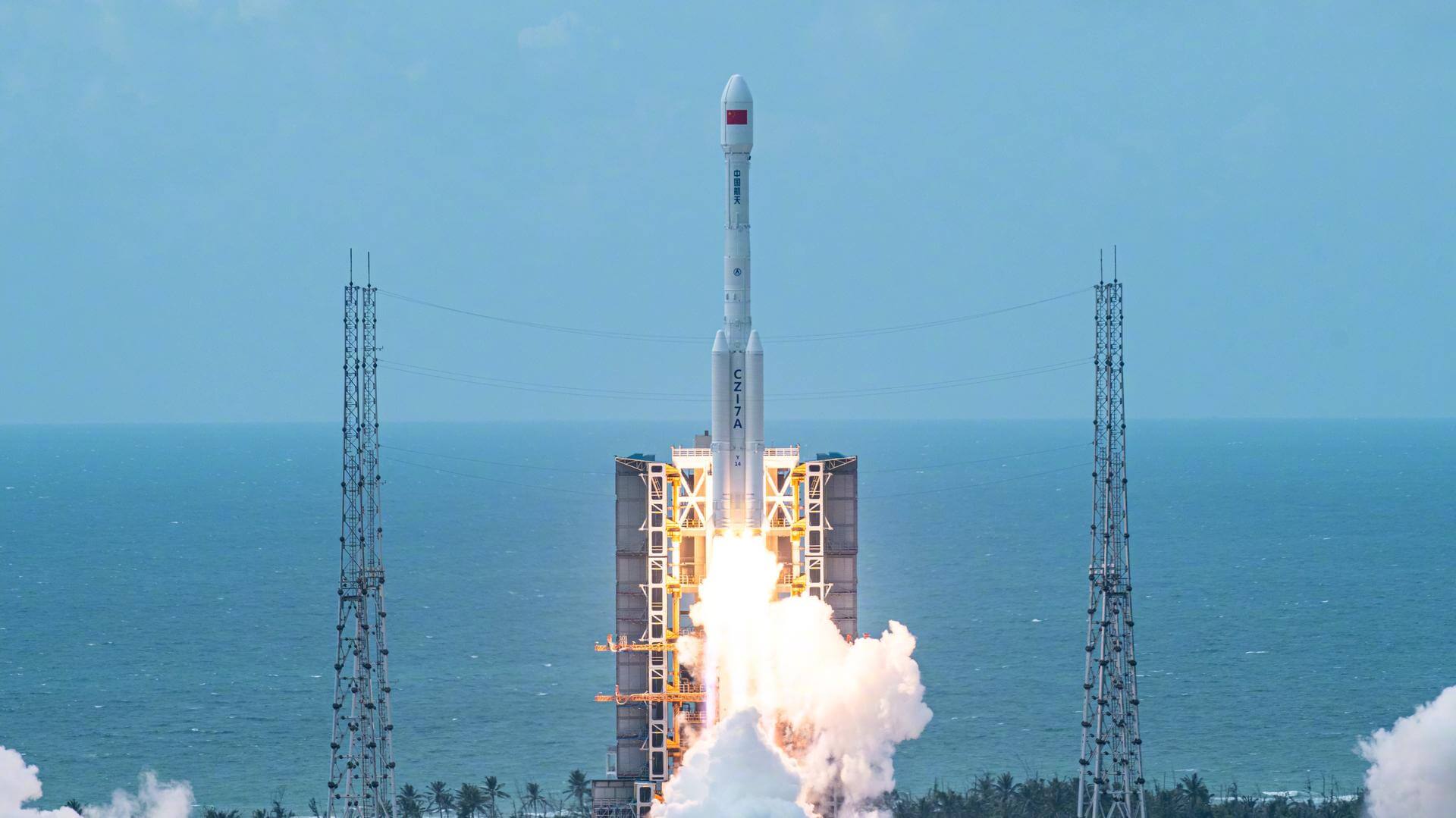
Launch facts
| Rocket | Long March 7A |
| Operator | China Aerospace Science and Technology Corporation |
| Pad | 201, Wenchang Space Launch Site, People's Republic of China |
| T-0 (UTC) | 26 May 2026 at 16:16 |
| Status | Success |
What happened?
China successfully launched the TJSW-24 satellite aboard a Long March 7A rocket on 26 May 2026 at 16:16 UTC from Pad 201 at the Wenchang Space Launch Site on Hainan Island. The mission was conducted by the China Aerospace Science and Technology Corporation (CASC) and was declared a success.
The Long March 7A is a three-stage medium-lift launch vehicle designed to deliver payloads to geosynchronous transfer orbit (GTO). It combines the kerosene/liquid-oxygen core of the Long March 7 with a hydrogen-fueled third stage and four strap-on boosters, giving it a GTO capacity of roughly 7,000 kg.
What is the payload?
TJSW-24 belongs to the Tongxin Jishu Shiyan Weixing ("Communication Technology Experiment Satellite") series, a family of Chinese satellites officially described as testing communications and related technologies in high orbit. The series has grown steadily since its debut, with each new spacecraft typically inserted toward geostationary altitude near 35,786 km.
As is standard for the TJSW program, CASC released limited technical detail about the satellite's specific instruments or mass. The spacecraft was placed into a geosynchronous transfer orbit, from which it will use onboard propulsion to raise its perigee and circularize at geostationary altitude over the coming weeks.
Why Long March 7A for this mission?
The Long March 7A fills a key gap in China's launch fleet as a modern, higher-capacity replacement for older hypergolic rockets flying GTO payloads. With four boosters and a hydrogen upper stage, it is optimized precisely for the kind of heavy geostationary-bound satellite that TJSW-24 represents.
Where did it launch from?
The launch used Pad 201 at the coastal Wenchang Space Launch Site, China's newest and southernmost orbital spaceport. Wenchang's low latitude — about 19 degrees north — provides an efficiency advantage for equatorial and geostationary missions, and its seaside location allows large rocket stages to be delivered by ship.
| Detail | Value |
|---|---|
| Rocket | Long March 7A |
| Payload | TJSW-24 |
| Operator | CASC |
| Launch date/time | 26 May 2026, 16:16 UTC |
| Pad | 201, Wenchang Space Launch Site |
| Target orbit | Geosynchronous transfer orbit |
| Result | Success |
Did the launch succeed?
Yes. The mission was declared a success, with the Long March 7A completing its ascent and delivering TJSW-24 to its intended transfer orbit. Chinese state media confirmed the outcome shortly after liftoff, consistent with CASC's standard post-launch reporting.
How the Long March 7A performs
The rocket stands roughly 60 meters tall and lifts off with the combined thrust of its core stage and four liquid-fueled strap-on boosters. Its use of RP-1 kerosene and liquid oxygen in the lower stages marks a shift away from the toxic hydrazine-based propellants used in earlier Chinese launchers, part of a broader modernization of the Long March family.
How to track the satellite
Newly launched geostationary satellites can be followed as they climb from transfer orbit to their final station. You can watch TJSW-24 and thousands of other spacecraft in real time on the Cosmik live 3D satellite map, and learn the basics on our guide to tracking satellites.
What's next?
China continues one of the busiest national launch cadences in the world, with multiple Long March variants flying communications, navigation, and Earth-observation payloads throughout the year. Follow the full rocket launch schedule and the latest launch news on Cosmik to stay ahead of upcoming missions from Wenchang and China's other spaceports.
Background sourced from CASC's mission statements and public launch records. Vehicle and spaceport details are drawn from the Long March 7A and Wenchang Space Launch Site references, with live launch data via The Space Devs API.
Follow along on Cosmik
Track TJSW-24 and every active satellite live on Cosmik's free 3D map, explore the upcoming launch tracker, and enable free launch alerts so you never miss a liftoff.
Follow this mission live in 3D and get a free alert before liftoff.
Open the live map →Sources
Next launches
- Dragon CRS-2 SpX-35 — launch time & how to watch — 13 October 2026, 10:33 UTC
- Martian Moon eXplorer (MMX) — launch time & how to watch — 19 October 2026, 19:41 UTC
- Amazon Leo (LV-01) — launch time & how to watch — 29 October 2026
More launch coverage
- Falcon 9 Starlink Group 17-41 Launch Recap — 30 May 2026 — 30 May 2026, 15:25 UTC
- Atlas V 551 Launches Amazon Leo (LA-07): 29 May 2026 Recap — 29 May 2026, 23:53 UTC
- Falcon 9 Starlink Group 10-53 Launch Recap — 29 May 2026 — 29 May 2026, 12:57 UTC
- Falcon 9 Starlink Group 17-37: Launch Succeeds 26 May 2026 — 26 May 2026, 14:50 UTC
- Starlink Group 10-47: Falcon 9 Launch Recap — 25 May 2026 — 25 May 2026, 11:48 UTC
- Shenzhou 23 Launch Success: Long March 2F Flew 24 May 2026 — 24 May 2026, 15:08 UTC