Zhuque-2E Block 2 Launch Recap: LandSpace Succeeds 14 May 2026
Published · Updated
Zhuque-2ELandSpaceJiuquanChina launch✓ recap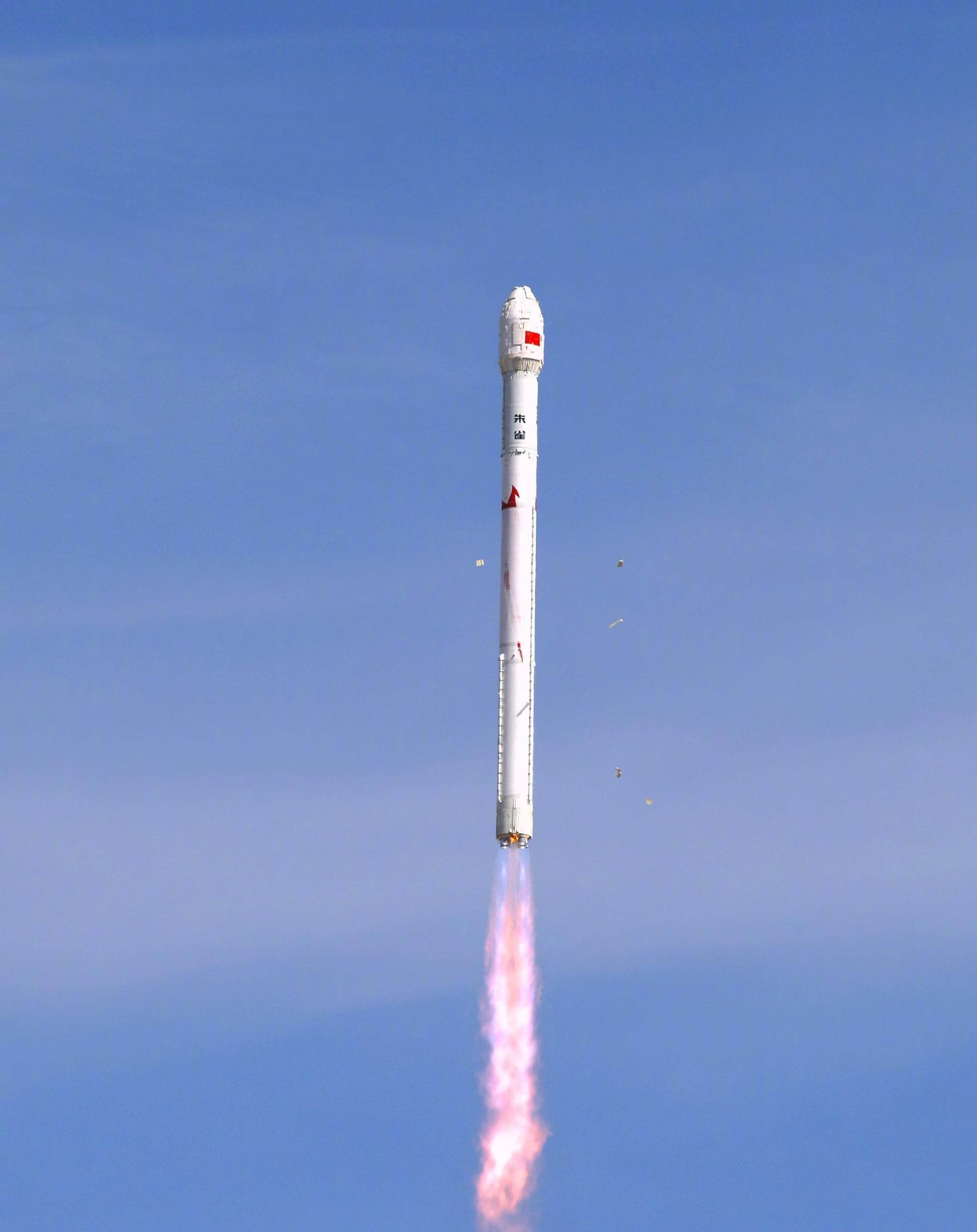
Launch facts
| Rocket | Zhuque-2E Block 2 |
| Operator | LandSpace |
| Pad | Launch Area 96A, Jiuquan Satellite Launch Center, People's Republic of China |
| T-0 (UTC) | 14 May 2026 at 03:00 |
| Status | Success |
Did the launch succeed?
Yes. LandSpace's Zhuque-2E Block 2 rocket lifted off successfully at 03:00 UTC on 14 May 2026 from Launch Area 96A at the Jiuquan Satellite Launch Center in the People's Republic of China, carrying a mass simulator payload. The mission was confirmed as a success, marking another milestone for the world's first liquid-oxygen/methane orbital launch vehicle family.
The Zhuque-2 series is a two-stage rocket built by Beijing-based private company LandSpace, and it holds the historic distinction of being the first methane-fueled (methalox) rocket to reach orbit, achieved in July 2023.
What is the Zhuque-2E Block 2?
The Zhuque-2E is an upgraded variant of the original Zhuque-2, featuring improved engines and a stretched propellant tank for higher payload capacity. The "Block 2" designation reflects further iterative enhancements to the vehicle's performance and reliability.
Key characteristics of the Zhuque-2 family:
- Propellant: Liquid oxygen and liquid methane (methalox), a cleaner and more reusable-friendly combination than traditional kerosene or hypergolic fuels.
- Stages: Two, both methane-powered.
- Historic first: First methalox rocket to reach orbit worldwide, in July 2023.
- Operator: LandSpace, one of China's leading commercial launch startups founded in 2015.
Why methane matters
Methalox propulsion is favored by modern rocket developers, including SpaceX and Blue Origin, because methane burns cleanly, leaves minimal residue on engine components, and can eventually be produced off-world. LandSpace's continued success with the Zhuque-2 line demonstrates that this technology is maturing across the global launch industry.
What was the payload?
This mission carried a mass simulator, a non-functional payload of known mass and dimensions used to validate vehicle performance and flight dynamics under realistic loading conditions. Mass simulators are standard practice for qualification flights of upgraded rocket variants, allowing engineers to verify structural, guidance, and propulsion behavior without risking an operational spacecraft.
Because the objective was vehicle qualification rather than satellite deployment, the primary success criteria centered on booster performance, stage separation, and reaching the targeted orbital parameters.
Where did it launch from?
The rocket flew from Launch Area 96A at the Jiuquan Satellite Launch Center, located in the Gobi Desert in northwestern China. Jiuquan is China's oldest and most active launch complex, historically the departure point for the country's crewed Shenzhou missions. Launch Area 96 is the dedicated commercial pad used by LandSpace for its methalox flights.
Launch timeline at a glance
| Detail | Value |
|---|---|
| Rocket | Zhuque-2E Block 2 |
| Operator | LandSpace |
| Liftoff | 03:00 UTC, 14 May 2026 |
| Pad | Launch Area 96A, Jiuquan |
| Payload | Mass simulator |
| Outcome | Success |
Why this launch matters
Each successful Zhuque-2 flight strengthens LandSpace's position as a frontrunner in China's rapidly growing commercial space sector. The company is developing reusable variants of its methalox vehicles, and qualification flights like this one, carrying instrumented mass simulators, are essential steps toward validating hardware upgrades before committing paying customers' satellites to orbit.
The mission also underscores the broader global shift toward methane-fueled launch systems. With this success, LandSpace continues to prove the operational viability of a propulsion approach that many next-generation heavy-lift rockets rely on.
How to track the mission live
You can follow the trajectory and orbital position of objects from this and other launches on Cosmik's live 3D solar system and satellite map. Explore upcoming missions on our rocket launch schedule and read the latest launch news for ongoing coverage of China's commercial launch providers. If you want to learn the fundamentals, see our guide on how to track satellites.
Background on the vehicle and operator is available via Zhuque-2 on Wikipedia, LandSpace on Wikipedia, and the Jiuquan Satellite Launch Center. Launch data is sourced from The Space Devs Launch Library.
Follow the next launch on Cosmik
Never miss a liftoff. Track every rocket and satellite in real time on Cosmik's free 3D map, browse the full launch schedule, and enable free launch alerts to get notified the moment the next Zhuque-2 or any mission worldwide counts down to launch.
Follow this mission live in 3D and get a free alert before liftoff.
Open the live map →Sources
Next launches
- Dragon CRS-2 SpX-35 — launch time & how to watch — 13 October 2026, 10:33 UTC
- Martian Moon eXplorer (MMX) — launch time & how to watch — 19 October 2026, 19:41 UTC
- Amazon Leo (LV-01) — launch time & how to watch — 29 October 2026
More launch coverage
- Long March 8 Launches SpaceSail Polar Group #9 — 17 May 2026 Recap — 17 May 2026, 14:42 UTC
- Falcon 9 Dragon CRS-2 SpX-34 Launch Success — 15 May 2026 — 15 May 2026, 22:05 UTC
- Kinetica 1 Launches 5 Satellites — 15 May 2026 Recap — 15 May 2026, 04:33 UTC
- Long March 6A Launches SpaceSail Polar Group #8 — 12 May 2026 Recap — 12 May 2026, 11:59 UTC
- Falcon 9 NROL-172 Launch Recap: Success on 12 May 2026 — 12 May 2026, 02:13 UTC
- Long March 7 Tianzhou-10: Launch Recap (11 May 2026) — 11 May 2026, 00:14 UTC