Long March 3B/E Launches Tianlian 2-06 — 23 July 2026 Recap
Published · Updated
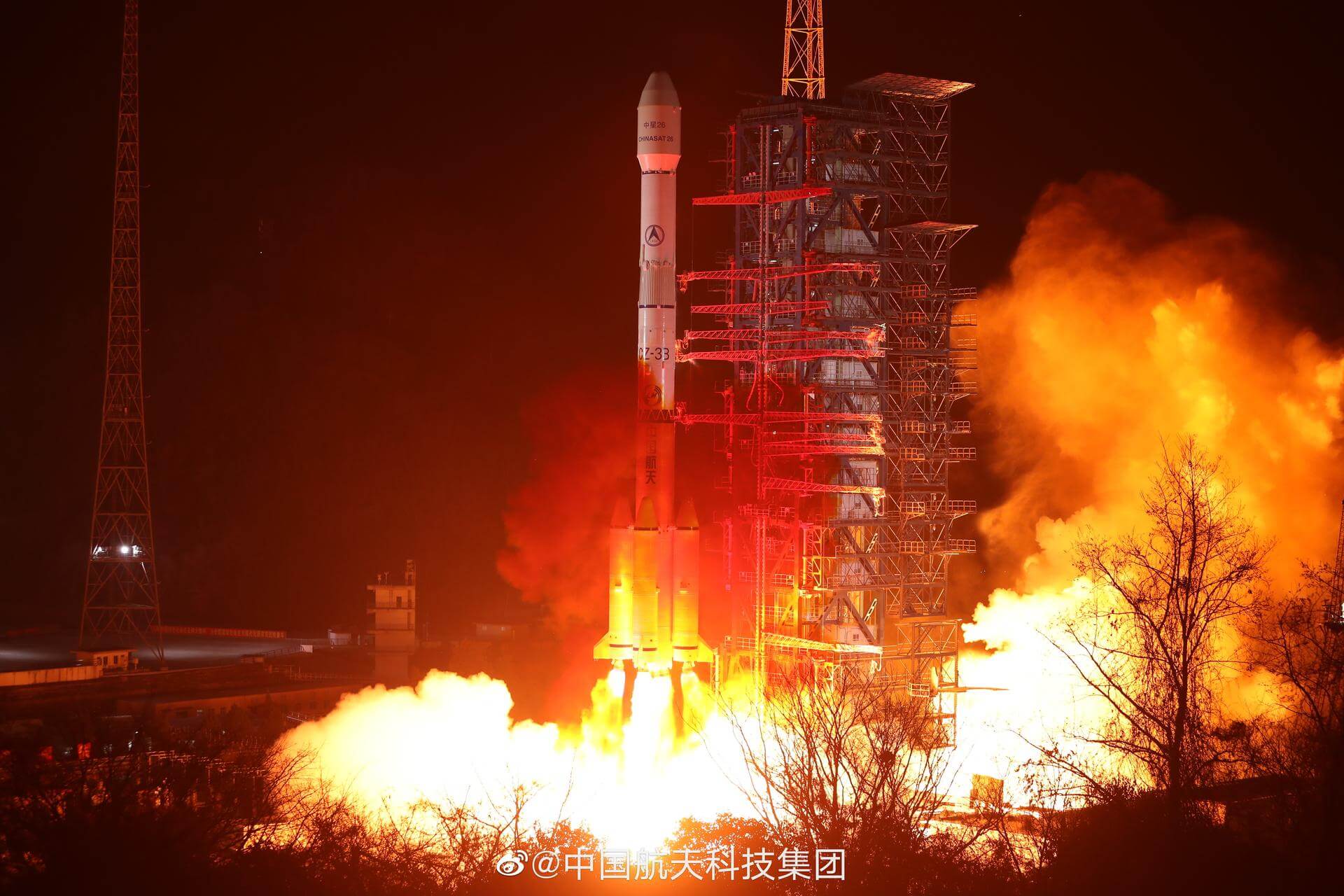
Launch facts
| Rocket | Long March 3B/E |
| Operator | China Aerospace Science and Technology Corporation |
| Pad | Launch Complex 2 (LC-2), Xichang Satellite Launch Center, People's Republic of China |
| T-0 (UTC) | 23 July 2026 at 12:00 |
| Status | Success |
What happened?
A Long March 3B/E rocket successfully launched the Tianlian 2-06 satellite on 23 July 2026 at 12:00 UTC from Launch Complex 2 (LC-2) at the Xichang Satellite Launch Center in the People's Republic of China. The Long March 3B/E is a three-stage, liquid-fueled heavy-lift rocket operated by the China Aerospace Science and Technology Corporation (CASC), and it delivered the data-relay spacecraft toward geostationary transfer orbit.
Tianlian 2 satellites are China's second-generation geostationary data-relay platforms, functioning as an orbital communications backbone that links spacecraft, crewed missions, and ground stations in near-real time.
Did the launch succeed?
Yes. The mission was confirmed a success. The Long March 3B/E lifted off on schedule and placed Tianlian 2-06 into its planned transfer orbit, from which the satellite will raise itself to a geostationary slot roughly 35,786 km above the equator.
Why the Tianlian network matters
The Tianlian system is the Chinese analogue of NASA's Tracking and Data Relay Satellite System (TDRSS). By stationing relay satellites in geostationary orbit, China maintains continuous communications coverage with low-Earth-orbit assets — including the Tiangong space station — that would otherwise be out of contact for large portions of each 90-minute orbit. Tianlian 2-06 adds redundancy and bandwidth to that constellation.
What is the Long March 3B/E?
The Long March 3B/E (Chang Zheng 3B/E) is an enhanced variant of the Long March 3B, China's workhorse for geostationary missions. Key characteristics:
| Attribute | Detail |
|---|---|
| Stages | 3 (plus 4 liquid strap-on boosters) |
| Height | ~56 m |
| GTO payload capacity | ~5,500 kg |
| Propellant | Hypergolic (N2O4 / UDMH), cryogenic third stage (LOX/LH2) |
| Launch site | Xichang, LC-2 |
The elongated
Follow this mission live in 3D and get a free alert before liftoff.
Open the live map →Sources
Next launches
- Falcon 9 Launches SDA Tranche 1 Tracking Layer E: Sept 30 — Q3 2026
- IRNSS-1L (NVS-03) on GSLV Mk II — launch time & how to watch — September 2026
- Chang'e 7 on Long March 5 — launch time & how to watch — September 2026
More launch coverage
- Starship Flight 13 Success: 24 July 2026 Launch Recap — 24 July 2026, 22:51 UTC
- Kinetica 1 Launches 5 Satellites — 23 July 2026 Recap — 23 July 2026, 23:33 UTC
- Kinetica 1 Launch: July 24, 2026 Time & How to Watch — 23 July 2026, 23:33 UTC
- Gravity-1 | 9 satellites — launch recap (22 July 2026) — 22 July 2026, 02:54 UTC
- Gravity-1 Launch: Sea-Based Liftoff Set for 31 July 2026 — 22 July 2026, 02:50 UTC
- Falcon 9 Launches MRV-1 from Cape Canaveral — July 21, 2026 — 21 July 2026, 21:15 UTC