Gravity-1 Launches 9 Satellites From Yellow Sea (July 22, 2026)
Published · Updated
Gravity-1Orienspacesea launchYellow Sea✓ recap
Launch facts
| Rocket | Gravity-1 |
| Operator | Orienspace Technology |
| Pad | Yellow Sea (launch location 5), Haiyang Oriental Spaceport |
| T-0 (UTC) | 22 July 2026 at 02:54 |
| Status | Success |
What happened?
Orienspace Technology's Gravity-1 rocket successfully launched 9 satellites from a floating sea-launch platform off Haiyang Oriental Spaceport in the Yellow Sea on 22 July 2026 at 02:54 UTC. The mission was declared a success by Orienspace, adding another flight to the record of the world's most powerful commercial solid-fuel launch vehicle.
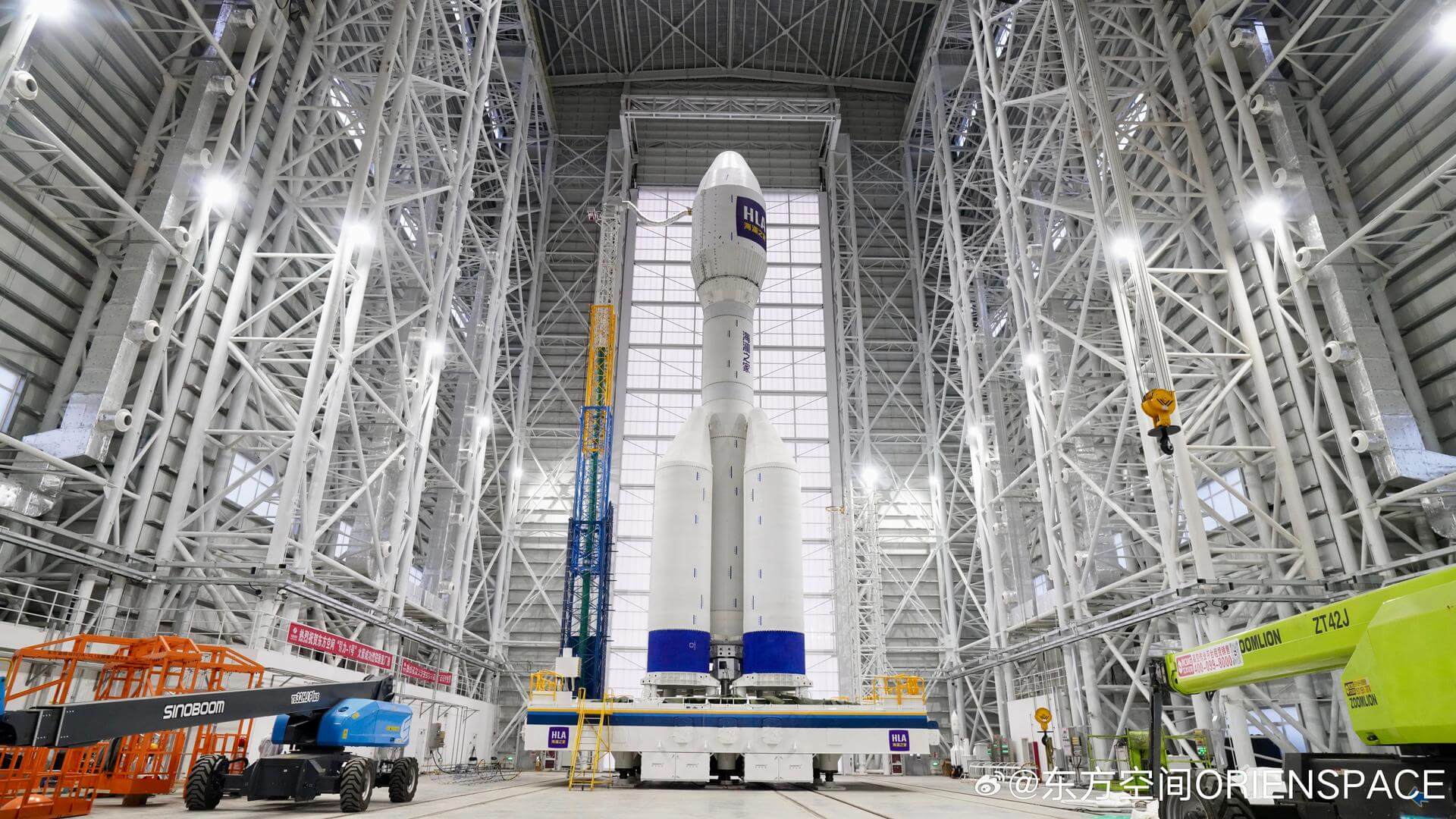
Gravity-1 (Yinli-1) is a Chinese medium-lift, solid-propellant rocket designed to deliver small satellite batches to low Earth orbit from a mobile ocean platform, removing the need for a fixed inland launch site.
Did the launch succeed?
Yes. According to Orienspace, the vehicle performed nominally through ascent and deployed all 9 satellites as planned. The flight lifted off precisely at the target time of 02:54 UTC from launch location 5 in the Yellow Sea.
Launch summary
| Detail | Value |
|---|---|
| Rocket | Gravity-1 |
| Operator | Orienspace Technology |
| Payload | 9 satellites |
| Launch site | Yellow Sea (launch location 5), Haiyang Oriental Spaceport |
| Liftoff | 22 July 2026, 02:54 UTC |
| Outcome | Success |
What is Gravity-1?
Gravity-1 is a three-stage, solid-fueled rocket bundled with four strap-on boosters, developed by the private Chinese company Orienspace. It stands roughly 30 meters tall and can lift approximately 6,500 kg to low Earth orbit, making it the most capable solid-propellant rocket ever flown commercially. Its debut flight in January 2024 was also conducted from a sea platform in the Yellow Sea, proving the ocean-launch concept that this mission repeated.
Sea-based launches offer two practical advantages: the platform can be positioned to drop spent stages safely over open water, and it avoids the congestion and downrange safety constraints of China's inland spaceports. Haiyang Oriental Spaceport, on the Shandong coast, serves as the maritime staging and integration hub for these operations.
What was the payload?
The mission carried 9 satellites to orbit. Grouped smallsat launches like this one are the core commercial use case for Gravity-1, which is engineered to serve China's expanding constellation and Earth-observation market with rapid, flexible access to low Earth orbit.
Why does this launch matter?
Each successful Gravity-1 flight strengthens the case for solid-propellant, sea-launched rockets as a fast-turnaround option for deploying satellite batches. Solid motors require no complex cryogenic fueling on the pad, allowing shorter launch campaigns, while the mobile platform decouples launch cadence from fixed-range availability. As one of a growing number of Chinese commercial launch providers, Orienspace is competing to capture demand from domestic operators building out communications and remote-sensing constellations.
How to watch live
This mission has already flown, so live coverage has ended. You can still follow the deployed satellites as they settle into their orbits on the Cosmik live 3D satellite map, and review upcoming missions on our rocket launch schedule. For the latest recaps and previews, visit Cosmik launch news.
Where can I track the satellites?
Once cataloged, the 9 satellites from this Gravity-1 flight will be visible in orbit on Cosmik. You can visualize their orbital paths and current positions in real time, and learn the fundamentals of orbital tracking on our guide to tracking satellites. To follow future Chinese commercial launches and other missions worldwide, keep an eye on the Cosmik launch tracker.
Background and sources
Gravity-1 belongs to a new generation of privately developed Chinese launch vehicles. Details of this flight are drawn from the launch data record. For further reference, see the following:
- Gravity-1 (Wikipedia)
- Orienspace (Wikipedia)
- The Space Devs Launch Library API — launch data source
Track it on Cosmik: Follow the newly deployed satellites live on the Cosmik 3D solar system and satellite map, and enable free launch alerts on our launch tracker so you never miss the next Gravity-1 flight or any mission worldwide.
Follow this mission live in 3D and get a free alert before liftoff.
Open the live map →Sources
Next launches
- Long March 3B/E Launch: Time & How to Watch (23 July 2026) — 23 July 2026 at 12:00 UTC
- Starship Flight 13: Launch Time & How to Watch (15 July 2026) — 23 July 2026 at 22:45 UTC
- Kinetica 1 Launch: July 24, 2026 Time & How to Watch — 23 July 2026 at 23:30 UTC