Ariane 64 Launches Amazon Leo LE-02 on 30 April 2026
Published · Updated
Ariane 64ArianespaceAmazon LeoProject Kuiper✓ recap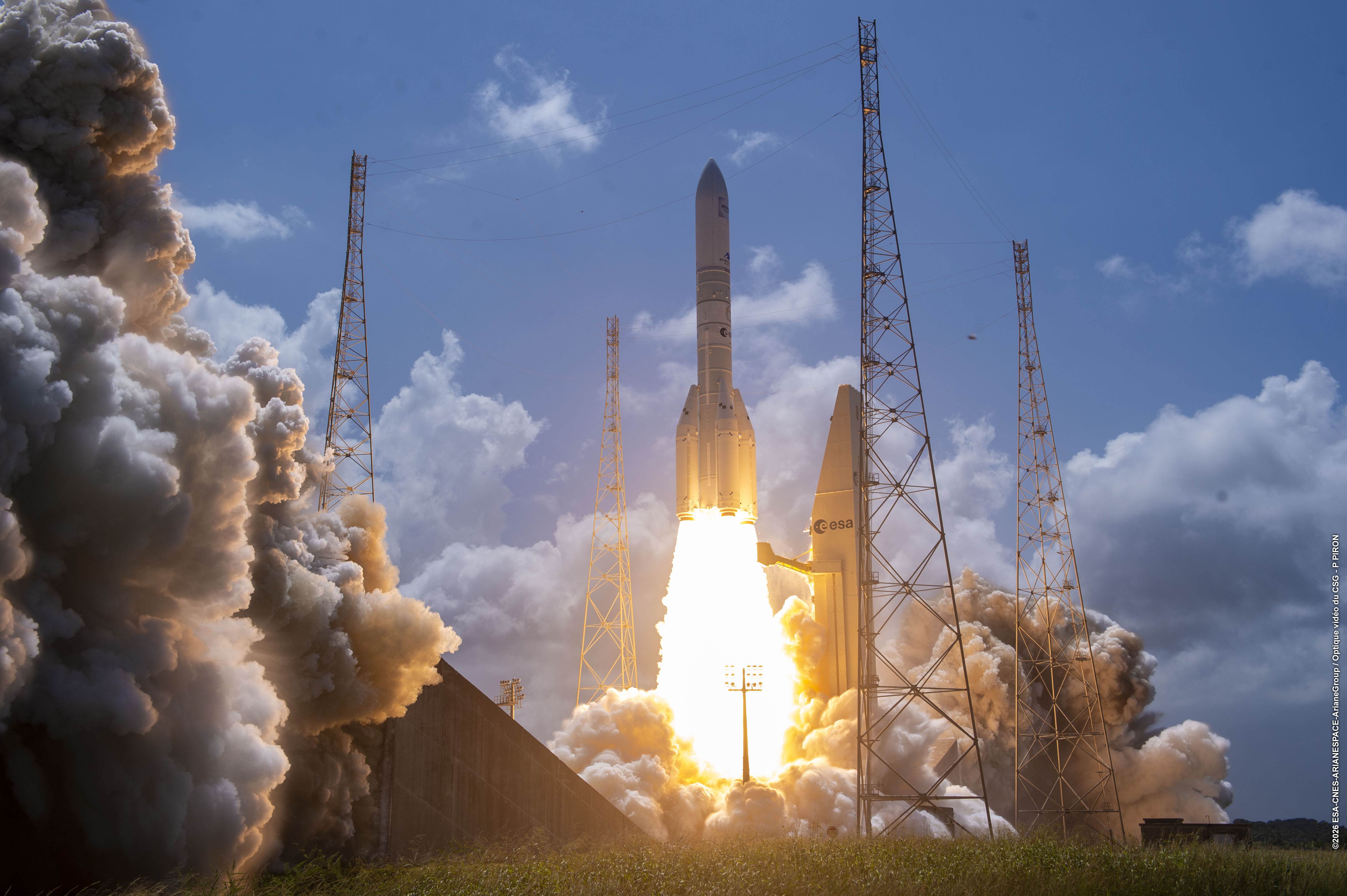
Launch facts
| Rocket | Ariane 64 |
| Operator | Arianespace |
| Pad | Ariane Launch Area 4, Guiana Space Centre, French Guiana |
| T-0 (UTC) | 30 April 2026 at 08:57 |
| Status | Success |
What happened?
An Ariane 64 rocket successfully launched the Amazon Leo (LE-02) batch of broadband satellites on 30 April 2026 at 08:57:15 UTC from Ariane Launch Area 4 at the Guiana Space Centre in French Guiana. Arianespace confirmed the flight reached its target low Earth orbit, marking another operational deployment for Amazon's satellite internet constellation.
The Ariane 64 is the heavy-lift variant of Europe's Ariane 6 rocket, distinguished by its four P120C solid-fuel boosters that give it the muscle to loft large payloads to low, medium, and geostationary orbits. LE-02 represents the second dedicated Amazon Leo mission flown on the vehicle.
What is the payload?
Amazon Leo — formerly branded Project Kuiper — is Amazon's low-Earth-orbit broadband constellation, designed to deliver high-speed internet to underserved regions worldwide. The full constellation is planned at more than 3,200 satellites, competing directly with SpaceX's Starlink network.
The satellites operate in low Earth orbit at altitudes near 600 km, where atmospheric drag ensures deorbiting at end of life and keeps latency low for consumers. Each LE-02 spacecraft carries phased-array antennas and inter-payload communications hardware to route traffic across the fleet.
Did the launch succeed?
Yes. According to Arianespace, the mission was a success. The four P120C boosters and Vulcain 2.1 core stage powered the vehicle off the pad at 08:57:15 UTC, with the reignitable Vinci upper stage completing the orbital insertion and satellite deployment.
Why does the Ariane 64 matter here?
The Ariane 6 family replaced the long-serving Ariane 5 and gives Europe independent, sovereign access to space for both institutional and commercial customers. The 64 configuration is optimized for heavy constellation deployments and high-energy trajectories.
- Configuration: Ariane 64, four P120C solid rocket boosters
- Core stage: Vulcain 2.1 liquid-hydrogen/liquid-oxygen engine
- Upper stage: Restartable Vinci engine
- Launch site: Ariane Launch Area 4 (ELA-4), Guiana Space Centre
French Guiana's near-equatorial location gives the Guiana Space Centre a performance boost from Earth's rotation, making it one of the most efficient launch sites in the world for eastbound orbital insertions.
Launch details at a glance
| Item | Detail |
|---|---|
| Mission | Amazon Leo (LE-02) |
| Rocket | Ariane 64 |
| Provider | Arianespace |
| Launch date/time | 30 April 2026, 08:57:15 UTC |
| Pad | Ariane Launch Area 4, Guiana Space Centre |
| Outcome | Success |
How to track the satellites
Now that the LE-02 batch is in orbit, you can follow the newly deployed satellites as they raise altitude and spread into their operational planes. Cosmik's live 3D solar-system and satellite map lets you watch objects circle Earth in real time, and our guide to tracking satellites explains how to spot fresh deployments overhead.
For upcoming missions from Arianespace and other operators, check the full rocket launch schedule and the latest launch news. You can also monitor the International Space Station as it passes over your location.
Background on the constellation race
Amazon Leo joins a growing field of low-Earth-orbit broadband networks. With a planned fleet exceeding 3,200 spacecraft, the constellation requires a sustained cadence of heavy-lift launches across multiple providers, including Arianespace, to reach full operational capacity. Each successful batch like LE-02 brings global coverage closer.
Launch data for this recap is sourced from The Space Devs Launch Library. Background on the vehicle and operator draws from public references below.
Follow the mission live on Cosmik
Track the Amazon Leo satellites in real time on Cosmik's free 3D map, browse the full launch calendar, and enable free launch alerts so you never miss the next Ariane 6 flight.
Follow this mission live in 3D and get a free alert before liftoff.
Open the live map →Sources
Next launches
- Dragon CRS-2 SpX-35 — launch time & how to watch — 13 October 2026, 10:33 UTC
- Martian Moon eXplorer (MMX) — launch time & how to watch — 19 October 2026, 19:41 UTC
- Amazon Leo (LV-01) — launch time & how to watch — 29 October 2026
More launch coverage
- Falcon 9 Launches CAS500-2 & Rideshares — 3 May 2026 Recap — 3 May 2026, 07:00 UTC
- Starlink Group 10-38: Falcon 9 Launch Recap (1 May 2026) — 1 May 2026, 18:06 UTC
- Soyuz-5 Debut Success: Maiden Flight Recap (30 April 2026) — 30 April 2026, 18:00 UTC
- Starlink Group 17-36 Launch Recap: Falcon 9 Success on 30 April 2026 — 30 April 2026, 02:42 UTC
- Falcon Heavy Launches ViaSat-3 F3: April 29, 2026 Recap — 29 April 2026, 14:13 UTC
- Atlas V 551 Launches Amazon Leo (LA-06) — April 28, 2026 Recap — 28 April 2026, 00:53 UTC