Falcon Heavy Launches ViaSat-3 F3: April 29, 2026 Recap
Published · Updated
Falcon HeavySpaceXViaSat-3ViaSat-3 F3✓ recap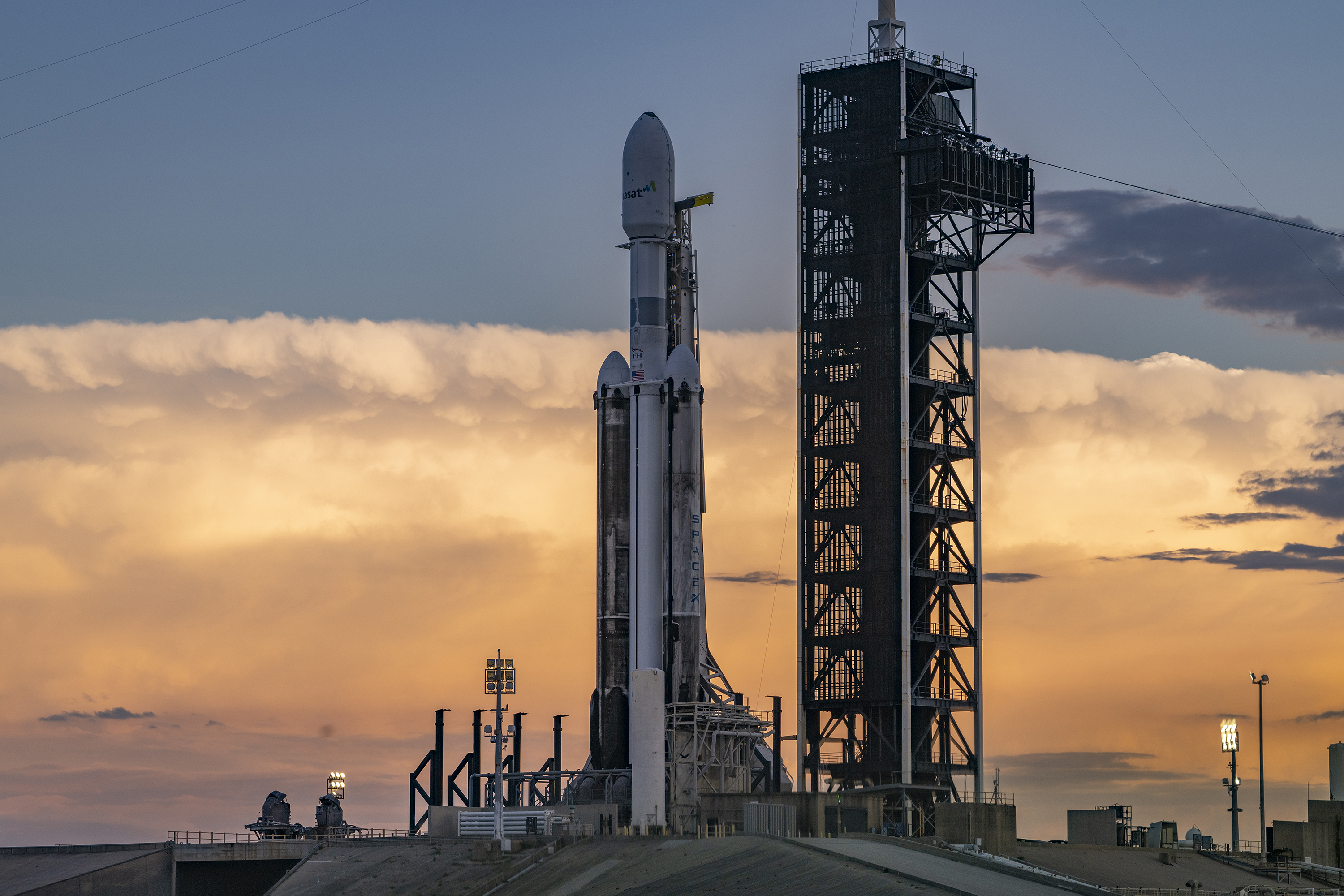
Launch facts
| Rocket | Falcon Heavy |
| Operator | SpaceX |
| Pad | Launch Complex 39A, Kennedy Space Center, FL, USA |
| T-0 (UTC) | 29 April 2026 at 14:13 |
| Status | Success |
What happened?
SpaceX successfully launched the ViaSat-3 F3 (ViaSat-3 Asia-Pacific) satellite aboard a Falcon Heavy rocket on April 29, 2026, at 14:13 UTC from Launch Complex 39A at NASA's Kennedy Space Center in Florida. Falcon Heavy is SpaceX's heavy-lift rocket, built from three Falcon 9-derived cores strapped together to generate roughly 5 million pounds of thrust at liftoff, making it the most powerful operational rocket in the SpaceX fleet.
The mission delivered the third and final satellite in Viasat's ViaSat-3 constellation, a series of ultra-high-capacity geostationary broadband satellites designed to provide internet connectivity across large regions of the globe. This flight completed the trio, adding coverage for the Asia-Pacific region.
Did the launch succeed?
Yes. According to SpaceX, the launch was a success. Falcon Heavy's three cores ignited on schedule, cleared the tower, and executed the ascent profile before the upper stage carried the ViaSat-3 F3 payload toward its geostationary transfer orbit.
Falcon Heavy typically flies its heaviest geostationary payloads in an expendable configuration, sacrificing booster recovery to maximize performance to the demanding transfer orbit required by satellites bound for the geostationary belt at roughly 35,786 kilometers altitude.
What is the payload?
ViaSat-3 F3 is the third satellite in Viasat's ViaSat-3 broadband constellation. Each ViaSat-3 spacecraft is among the highest-capacity commercial communications satellites ever built, engineered to deliver more than one terabit per second of aggregate throughput. The three-satellite constellation is designed to blanket three primary coverage zones:
- ViaSat-3 F1 — the Americas
- ViaSat-3 F2 — Europe, Middle East and Africa (EMEA)
- ViaSat-3 F3 — Asia-Pacific
Once fully operational in geostationary orbit, ViaSat-3 F3 will support consumer broadband, in-flight connectivity, maritime, and government communications across the Asia-Pacific region. Geostationary satellites orbit at the same rate the Earth rotates, allowing them to remain fixed over a single spot on the equator and provide continuous regional coverage.
Why Falcon Heavy?
The ViaSat-3 satellites are exceptionally massive, and their direct-to-geostationary-transfer requirements demand a heavy-lift launcher. Falcon Heavy, which first flew in February 2018, uses three Falcon 9 first stages and 27 Merlin engines firing together at liftoff. For missions this demanding, SpaceX often expends the center core and, in some cases, the side boosters to reserve enough propellant for the high-energy trajectory.
The launch site
Launch Complex 39A has a storied history — it hosted Apollo Moon missions and Space Shuttle launches before SpaceX leased and modified it for Falcon 9 and Falcon Heavy operations. It is the only pad SpaceX uses for Falcon Heavy flights.
How to watch and track it
SpaceX streamed the launch live via its webcast beginning shortly before liftoff. Now that ViaSat-3 F3 is in orbit, you can follow its journey to geostationary altitude and view every active satellite in real time on Cosmik's live 3D satellite map. To catch upcoming missions before they fly, check the full rocket launch schedule and browse more SpaceX launches.
| Detail | Value |
|---|---|
| Mission | ViaSat-3 F3 (Asia-Pacific) |
| Rocket | Falcon Heavy |
| Provider | SpaceX |
| Launch date/time | April 29, 2026, 14:13 UTC |
| Launch site | LC-39A, Kennedy Space Center, FL |
| Target orbit | Geostationary transfer orbit |
| Status | Success |
What's next for the ViaSat-3 constellation?
With F3 now launched, all three ViaSat-3 satellites have been deployed, completing Viasat's plan for near-global broadband coverage spanning the Americas, EMEA, and Asia-Pacific. Each satellite will spend several weeks raising itself into its final geostationary slot and undergoing in-orbit testing before entering commercial service.
For the latest launch coverage and mission updates, visit the Cosmik launch news feed. You can also learn how to track satellites from your location.
Sources and further reading
- Falcon Heavy (Wikipedia)
- SpaceX (Wikipedia)
- Kennedy Space Center LC-39 (Wikipedia)
- The Space Devs Launch Library (data source)
Follow ViaSat-3 F3 live on Cosmik. Track the newly deployed satellite as it climbs toward geostationary orbit on our real-time 3D map, and enable free launch alerts so you never miss the next Falcon Heavy mission.
Follow this mission live in 3D and get a free alert before liftoff.
Open the live map →Sources
Next launches
- Dragon CRS-2 SpX-35 — launch time & how to watch — 13 October 2026, 10:33 UTC
- Martian Moon eXplorer (MMX) — launch time & how to watch — 19 October 2026, 19:41 UTC
- Amazon Leo (LV-01) — launch time & how to watch — 29 October 2026
More launch coverage
- Soyuz-5 Debut Success: Maiden Flight Recap (30 April 2026) — 30 April 2026, 18:00 UTC
- Ariane 64 Launches Amazon Leo LE-02 on 30 April 2026 — 30 April 2026, 08:57 UTC
- Starlink Group 17-36 Launch Recap: Falcon 9 Success on 30 April 2026 — 30 April 2026, 02:42 UTC
- Atlas V 551 Launches Amazon Leo (LA-06) — April 28, 2026 Recap — 28 April 2026, 00:53 UTC
- Falcon 9 Starlink 17-16 Launch Recap: Success on 26 April 2026 — 26 April 2026, 14:37 UTC
- Soyuz 2.1a Progress MS-34 Launch Success — 25 April 2026 — 25 April 2026, 22:21 UTC