Soyuz-5 Debut Success: Maiden Flight Recap (30 April 2026)
Published · Updated
Soyuz-5RKK EnergiyaBaikonurmaiden flight✓ recap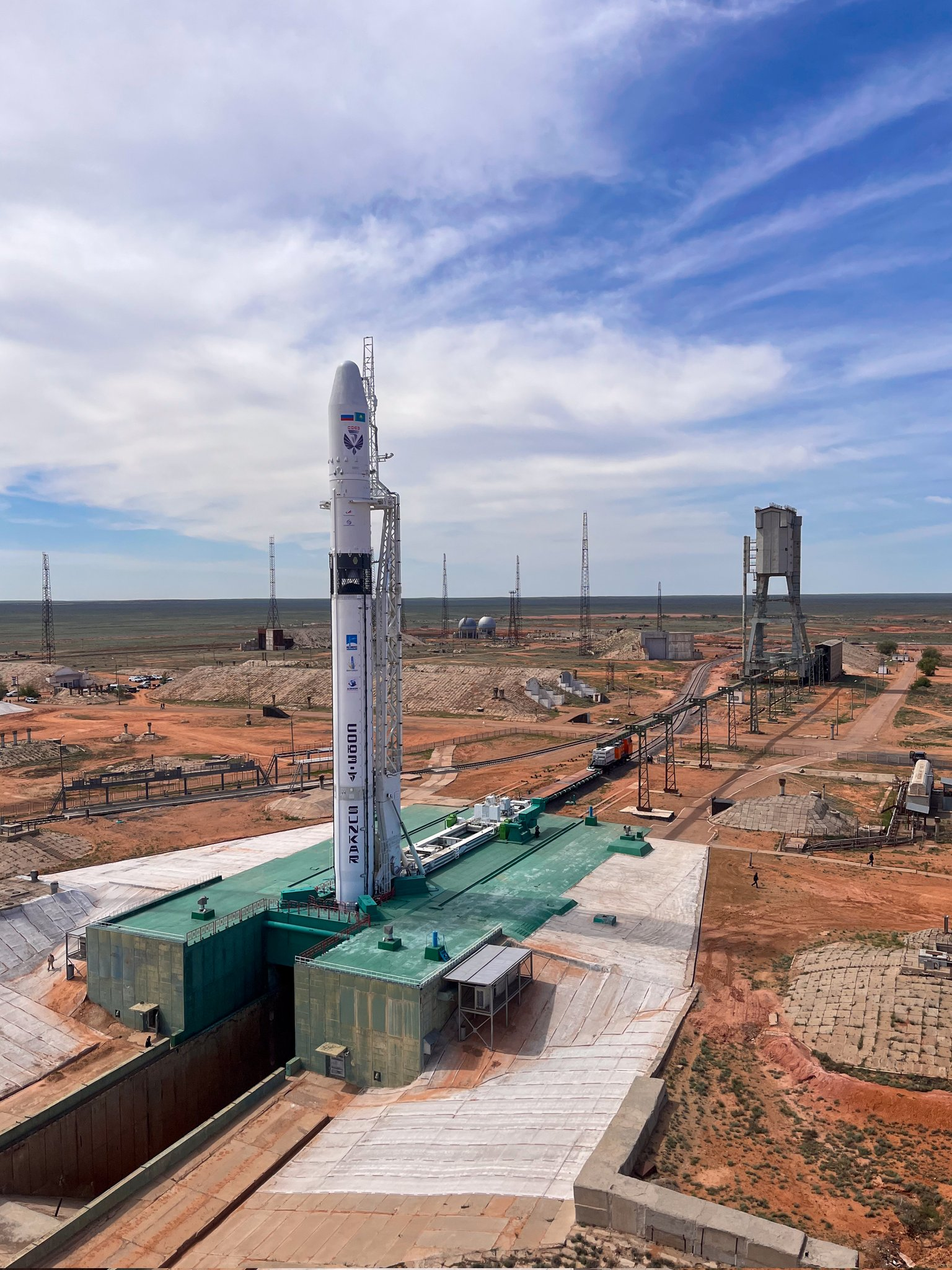
Launch facts
| Rocket | Soyuz-5 |
| Operator | RKK Energiya |
| Pad | 45/1, Baikonur Cosmodrome, Republic of Kazakhstan |
| T-0 (UTC) | 30 April 2026 at 18:00 |
| Status | Success |
Did the Soyuz-5 launch succeed?
The Soyuz-5 rocket completed a successful maiden demonstration flight on 30 April 2026 at 18:00 UTC, lifting off from Site 45/1 at the Baikonur Cosmodrome in the Republic of Kazakhstan. The mission, operated by RKK Energiya, marked the first orbital flight of Russia's new medium-lift launch vehicle and was declared a success.
Soyuz-5 (also designated Irtysh) is a two-stage kerosene-and-liquid-oxygen rocket developed to replace the retired Zenit-2 and to serve as a building block for future Russian heavy-lift and crewed vehicles.
What is Soyuz-5?
Soyuz-5 is a next-generation medium-class launcher designed to place payloads into low Earth orbit and beyond. Despite sharing the Soyuz name, it is an entirely new design distinct from the veteran Soyuz-2 family, drawing instead on heritage from the Zenit rocket that flew from the 1980s onward.
The vehicle uses the powerful RD-171MV engine on its first stage — one of the highest-thrust liquid-propellant engines ever built — and an RD-0124MS engine on its second stage. The rocket is engineered to deliver roughly 17 tonnes to low Earth orbit, positioning it in the same medium-lift class as other modern two-stage launchers.
Why does this debut matter?
The maiden flight is a milestone for Russia's post-Zenit launch strategy. According to RKK Energiya, Soyuz-5 is intended to modernize the country's medium-lift capability and to underpin the planned Soyuz-6 and future super-heavy vehicles. Its first stage is also central to designs for reusable and clustered configurations.
- Rocket: Soyuz-5 (Irtysh)
- Operator: RKK Energiya
- Launch site: Site 45/1, Baikonur Cosmodrome, Kazakhstan
- Liftoff: 30 April 2026, 18:00 UTC
- Outcome: Success
- Mission type: Demonstration / maiden flight
What was the payload?
As a demonstration flight, the primary objective was to validate the rocket's design, propulsion, staging, and flight software rather than to deliver an operational commercial payload. Maiden flights of new launch vehicles are typically flown to confirm that all systems perform as engineered before higher-value missions are entrusted to the rocket. The successful outcome clears a critical hurdle toward operational service.
Where did it launch from?
The launch used Site 45/1 at Baikonur Cosmodrome, the world's oldest and one of its largest operational spaceports. Baikonur has hosted crewed and uncrewed launches since 1957, including the first human spaceflight in 1961. Pad 45 was historically associated with Zenit operations, making it a natural home for the Zenit-derived Soyuz-5.
| Parameter | Detail |
|---|---|
| Rocket family | Soyuz-5 / Irtysh |
| Stages | Two (RD-171MV + RD-0124MS) |
| Approx. LEO capacity | ~17 tonnes |
| Provider | RKK Energiya |
| Spaceport | Baikonur, Kazakhstan |
How to watch and track the mission
The launch broadcast was carried by Russian state and RKK Energiya channels ahead of the 18:00 UTC liftoff. Now that the flight is complete, you can follow any objects placed in orbit and monitor upcoming launches directly on Cosmik. Explore the live 3D satellite map to visualize orbits in real time, and check the rocket launch schedule for what flies next.
What comes next for Soyuz-5?
With a successful maiden flight on the record, RKK Energiya can proceed toward qualifying Soyuz-5 for operational payloads. The vehicle is expected to carry commercial and government satellites and to feed into Russia's broader roadmap of derivative launchers. Follow developments on the latest launch news page.
Launch data is sourced from The Space Devs Launch Library. Background on the vehicle and spaceport is drawn from the Soyuz-5 and Baikonur Cosmodrome references, with operator details per RKK Energiya.
Follow every launch live on Cosmik
Track newly launched satellites and watch the next mission unfold in real time on Cosmik's free 3D solar-system and satellite map. Enable free launch alerts so you never miss a liftoff — start with the launch tracker and the live map.
Follow this mission live in 3D and get a free alert before liftoff.
Open the live map →Sources
Next launches
- Dragon CRS-2 SpX-35 — launch time & how to watch — 13 October 2026, 10:33 UTC
- Martian Moon eXplorer (MMX) — launch time & how to watch — 19 October 2026, 19:41 UTC
- Amazon Leo (LV-01) — launch time & how to watch — 29 October 2026
More launch coverage
- Falcon 9 Starlink Group 17-29: Launch Success on 6 May 2026 — 6 May 2026, 03:59 UTC
- Falcon 9 Launches CAS500-2 & Rideshares — 3 May 2026 Recap — 3 May 2026, 07:00 UTC
- Starlink Group 10-38: Falcon 9 Launch Recap (1 May 2026) — 1 May 2026, 18:06 UTC
- Ariane 64 Launches Amazon Leo LE-02 on 30 April 2026 — 30 April 2026, 08:57 UTC
- Starlink Group 17-36 Launch Recap: Falcon 9 Success on 30 April 2026 — 30 April 2026, 02:42 UTC
- Falcon Heavy Launches ViaSat-3 F3: April 29, 2026 Recap — 29 April 2026, 14:13 UTC