Long March 5 | TJSW-25 Launch Recap: Success on 11 June 2026
Published · Updated
Long March 5TJSW-25China Aerospace Science and Technology CorporationWenchang✓ recap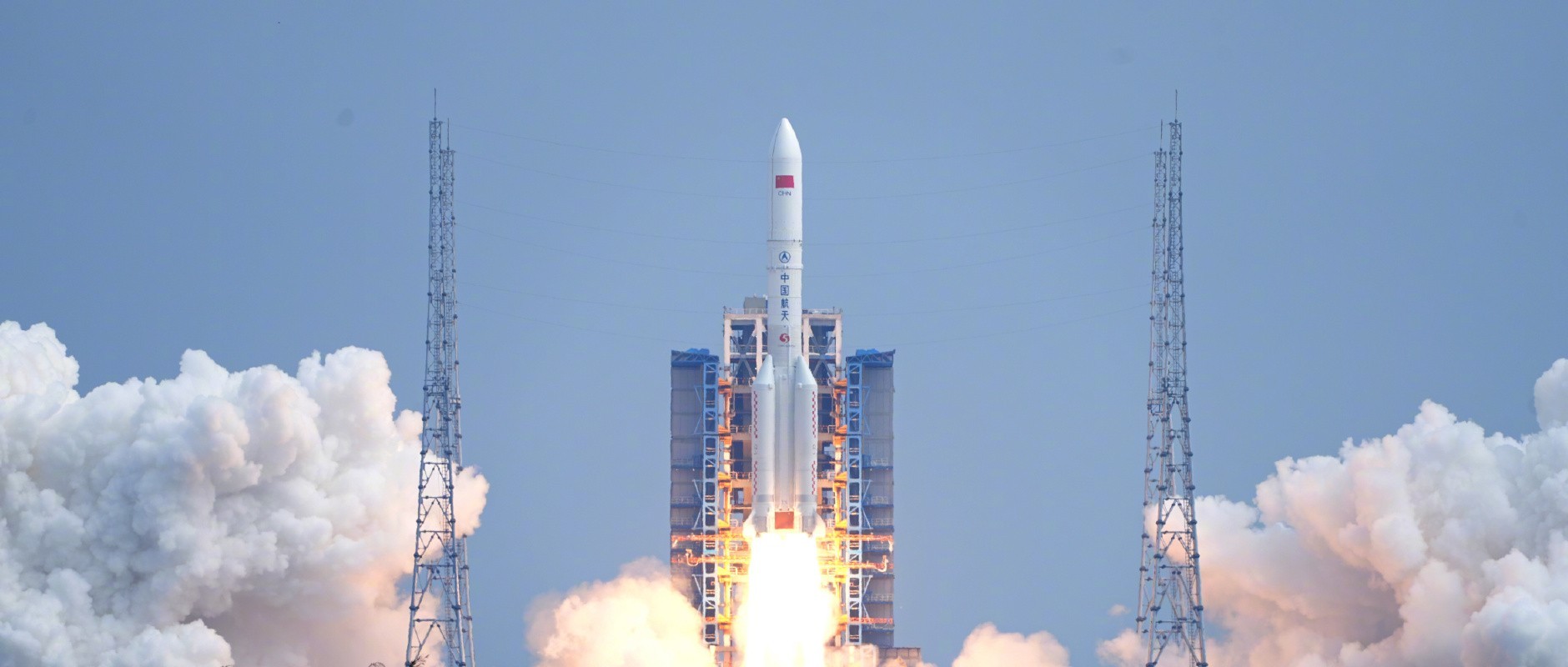
Launch facts
| Rocket | Long March 5 |
| Operator | China Aerospace Science and Technology Corporation |
| Pad | 101, Wenchang Space Launch Site, People's Republic of China |
| T-0 (UTC) | 11 June 2026 at 07:30 |
| Status | Success |
What happened?
A Long March 5 rocket successfully launched the TJSW-25 satellite from Pad 101 at the Wenchang Space Launch Site, People's Republic of China, on 11 June 2026 at 07:30 UTC. The mission, operated by the China Aerospace Science and Technology Corporation (CASC), reached orbit as planned and was declared a success.
The Long March 5 is China's largest operational rocket, a heavy-lift, two-stage vehicle roughly 57 meters tall and capable of delivering about 25 tonnes to low Earth orbit or roughly 14 tonnes to geostationary transfer orbit. It is the backbone of China's most demanding missions, from lunar sample return to space station modules.
Did the launch succeed?
Yes. According to CASC's flight designation, the TJSW-25 mission was confirmed successful following liftoff at 07:30 UTC. The Long March 5 uses cryogenic propulsion throughout: its core stage burns liquid hydrogen and liquid oxygen fed by two YF-77 engines, flanked by four liquid-fueled boosters powered by YF-100 engines producing the majority of the vehicle's initial thrust.
Key mission facts
| Detail | Value |
|---|---|
| Rocket | Long March 5 |
| Payload | TJSW-25 (Tongxin Jishu Shiyan Weixing 25) |
| Launch time | 11 June 2026, 07:30 UTC |
| Launch site | Pad 101, Wenchang, Hainan |
| Operator | China Aerospace Science and Technology Corporation |
| Outcome | Success |
What is the payload?
TJSW-25 is the latest in China's Tongxin Jishu Shiyan Weixing ("communications technology experiment satellite") series. The satellites are officially described by Chinese state media as testbeds for communication technologies and multiband, high-speed satellite communications. Western analysts frequently associate the class with geostationary missions, and the use of the heavy-lift Long March 5 is consistent with a large, high-orbit spacecraft rather than a small demonstrator.
The TJSW designation has been applied across numerous launches, and the "25" places this mission among the more numerous entries in the series. As is standard for these satellites, CASC released limited technical detail about the payload's exact mass, capabilities and final orbit.
Why launch from Wenchang?
The Wenchang Space Launch Site sits on Hainan Island at roughly 19 degrees north latitude, the lowest-latitude spaceport in China. That location gives rockets a stronger boost from Earth's rotation for equatorial and geostationary missions, and its coastal position allows the oversized Long March 5 stages to be delivered by sea. Pad 101 is one of two pads at the site purpose-built for the Long March 5 family, which is too large to be transported by rail to inland launch centers.
The Long March 5 track record
The Long March 5 first flew in 2016 and has become central to China's flagship deep-space campaigns, having launched the Chang'e-5 lunar sample-return mission, the Tianwen-1 Mars orbiter and rover, and the core module of the Tiangong space station. Its variant, the Long March 5B, is optimized for heavy low-Earth-orbit payloads such as station modules. Each successful flight reinforces the vehicle's role as China's primary heavy-lift capability.
How to track TJSW-25 and future launches
You can follow objects launched into orbit, including the newest Chinese satellites, on Cosmik's live 3D satellite map. Once cataloged, spacecraft can be located and their orbital paths visualized in real time. Explore upcoming missions on our rocket launch schedule, and read more coverage on the latest launch news page.
For readers new to orbital tracking, our guide on how to track satellites explains how publicly available orbital data lets anyone follow a spacecraft across the sky.
Sources and further reading
- Long March 5 (Wikipedia)
- Wenchang Space Launch Site (Wikipedia)
- China Aerospace Science and Technology Corporation (Wikipedia)
- The Space Devs Launch Library (data source)
Follow the mission live on Cosmik
Track TJSW-25 and every satellite in orbit on Cosmik's free real-time 3D map, and enable free launch alerts so you never miss the next Long March 5 liftoff. Head to gocosmik.com/launches to watch the countdown to the next mission.
Follow this mission live in 3D and get a free alert before liftoff.
Open the live map →Sources
Next launches
- Dragon CRS-2 SpX-35 — launch time & how to watch — 13 October 2026, 10:33 UTC
- Martian Moon eXplorer (MMX) — launch time & how to watch — 19 October 2026, 19:41 UTC
- Amazon Leo (LV-01) — launch time & how to watch — 29 October 2026
More launch coverage
- H3-30 Test Flight: Launch Recap for 12 June 2026 — 12 June 2026, 00:53 UTC
- Starlink Group 17-44 Launch Recap: Falcon 9 Succeeds June 11, 2026 — 11 June 2026, 15:05 UTC
- HASTE 'Curveball' Launch Recap: Rocket Lab Succeeds June 11, 2026 — 11 June 2026, 08:00 UTC
- Zhuque-2E Block 2 Launches 2 SatNet Satellites — 9 June 2026 Recap — 9 June 2026, 08:23 UTC
- Falcon 9 Starlink Group 10-35: Launch Recap (8 June 2026) — 8 June 2026, 10:13 UTC
- Falcon 9 Starlink Group 17-43 Launch Recap — 7 June 2026 — 7 June 2026, 04:24 UTC