Long March 3B/E Launches Shijian 31 — 16 June 2026 Recap
Published · Updated
Long March 3BShijian 31China launchCASC✓ recap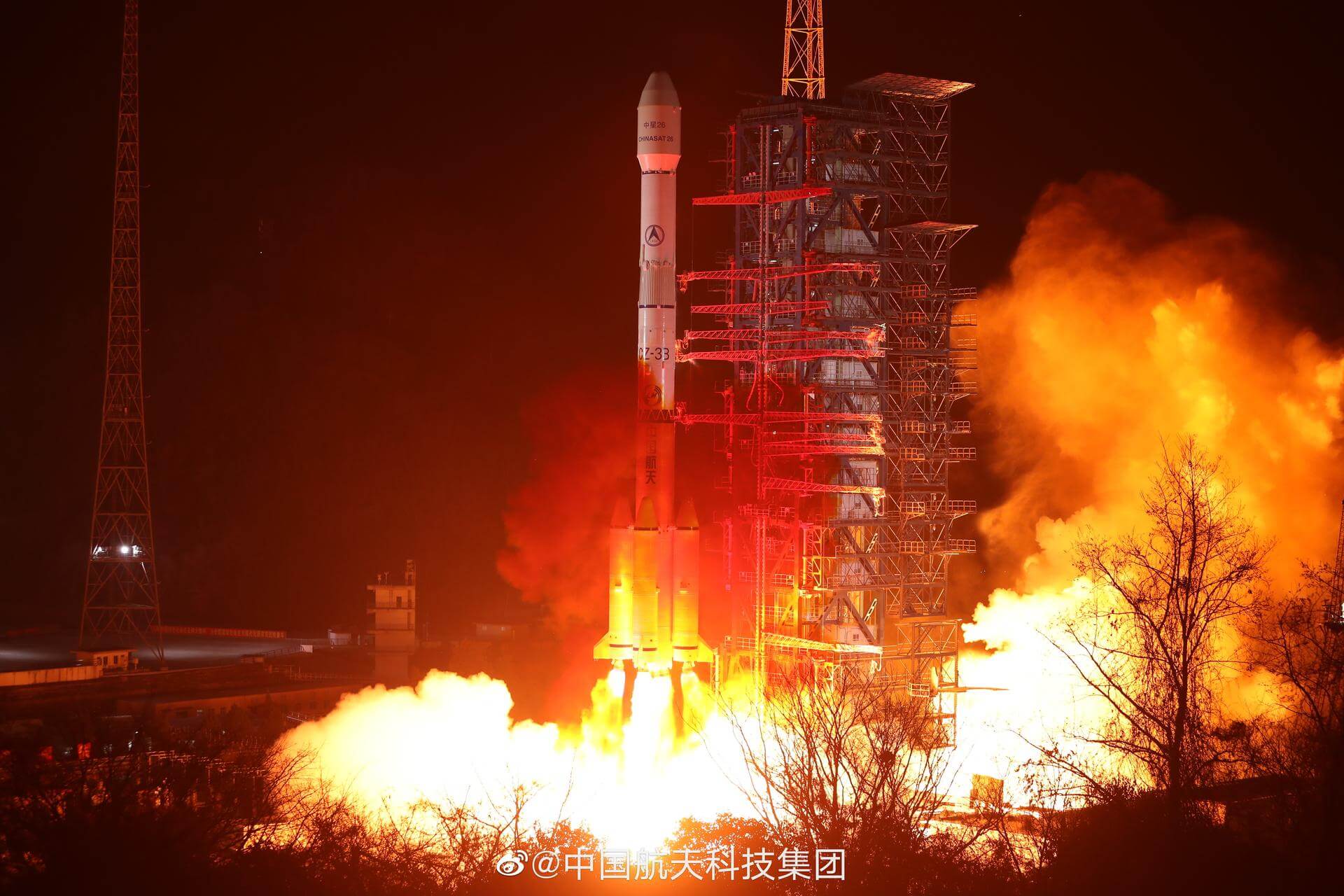
Launch facts
| Rocket | Long March 3B/E |
| Operator | China Aerospace Science and Technology Corporation |
| Pad | Launch Complex 2 (LC-2), Xichang Satellite Launch Center, People's Republic of China |
| T-0 (UTC) | 16 June 2026 at 09:45 |
| Status | Success |
What happened?
A Long March 3B/E rocket successfully launched the Shijian 31 satellite on 16 June 2026 at 09:45 UTC from Launch Complex 2 (LC-2) at the Xichang Satellite Launch Center in southwest China. The mission, operated by the China Aerospace Science and Technology Corporation (CASC), was declared a success shortly after the payload reached its intended transfer orbit.
The Long March 3B/E is China's most powerful satellite launcher for geostationary missions — a three-stage, liquid-fueled rocket standing about 56 meters tall with four strap-on boosters, capable of delivering roughly 5,500 kg to geostationary transfer orbit (GTO).
Did the launch succeed?
Yes. According to CASC, the vehicle performed nominally through all three stages, placing Shijian 31 on its planned trajectory toward geostationary orbit. Xichang remains China's primary base for high-orbit missions, and the Long March 3B family has flown dozens of successful GTO deliveries since its debut in 1996.
Key mission facts
| Parameter | Detail |
|---|---|
| Rocket | Long March 3B/E |
| Payload | Shijian 31 |
| Launch date/time | 16 June 2026, 09:45 UTC |
| Launch site | LC-2, Xichang Satellite Launch Center |
| Operator | China Aerospace Science and Technology Corporation |
| Outcome | Success |
What is the payload?
Shijian 31 belongs to China's long-running Shijian ("Practice") series of technology-demonstration satellites, a program that has flown since the early 1970s to test new spacecraft platforms, instruments, and orbital techniques. Chinese state descriptions of Shijian-class satellites typically cite science experiments and space-environment technology verification as their purpose.
The satellite was delivered toward geostationary transfer orbit, the standard drop-off for spacecraft destined for the geostationary belt roughly 35,786 km above the equator, where a satellite's orbital period matches Earth's rotation and it appears fixed over one longitude.
Why does the Long March 3B/E matter?
The Long March 3B/E ("Enhanced") is the workhorse behind most of China's geostationary launches, including communications, navigation, and weather spacecraft. Its first stage and four boosters burn a hypergolic mix of unsymmetrical dimethylhydrazine and nitrogen tetroxide, while the third stage uses cryogenic liquid hydrogen and liquid oxygen for the final push to high orbit.
Xichang, located in Sichuan Province, is one of four major Chinese launch centers and specializes in GTO missions thanks to its lower latitude, which improves payload performance for equatorial-bound spacecraft. This flight added to China's steady 2026 launch cadence, with the country continuing to average dozens of orbital missions per year.
How to watch and track it
Chinese GTO launches are not typically broadcast live in full, and official confirmation usually follows within minutes of a successful insertion. Once Shijian 31 raises itself to its final geostationary slot, it can be followed alongside thousands of other spacecraft on the Cosmik live 3D satellite map.
To see upcoming Chinese and global missions, browse the full rocket launch schedule, and keep up with mission outcomes on the latest launch news feed. If you want to learn the basics of following objects in orbit, see our guide on how to track satellites.
Where can I learn more?
- Long March 3B (Wikipedia)
- Xichang Satellite Launch Center (Wikipedia)
- China Aerospace Science and Technology Corporation (Wikipedia)
- The Space Devs Launch Library (data source)
Follow the mission live on Cosmik
Track Shijian 31 and every active satellite in real time on the Cosmik 3D map, and enable free launch alerts so you never miss the next Long March liftoff. Explore more upcoming flights on our launch tracker.
Follow this mission live in 3D and get a free alert before liftoff.
Open the live map →Sources
Next launches
- Dragon CRS-2 SpX-35 — launch time & how to watch — 13 October 2026, 10:33 UTC
- Martian Moon eXplorer (MMX) — launch time & how to watch — 19 October 2026, 19:41 UTC
- Amazon Leo (LV-01) — launch time & how to watch — 29 October 2026
More launch coverage
- Falcon 9 Launches AST SpaceMobile BlueBird Block 2 (17 June 2026) — 17 June 2026, 06:39 UTC
- Kuaizhou 11 Launches CentiSpace-1 Group 05 — 17 June 2026 Recap — 17 June 2026, 03:58 UTC
- Long March 12 Launches SatNet LEO Group 22 — 17 June 2026 Recap — 17 June 2026, 02:44 UTC
- Falcon 9 Starlink Group 17-54 Launch Recap — 15 June 2026 — 15 June 2026, 15:34 UTC
- Kinetica 1 Launches 8 Jilin-1 Satellites — 15 June 2026 Recap — 15 June 2026, 03:44 UTC
- Starlink Group 10-54: Falcon 9 Launch Recap (12 June 2026) — 12 June 2026, 12:37 UTC