SDA Tranche 1 Transport Layer E: Falcon 9 Launch Recap
Published · Updated
SpaceXFalcon 9SDASpace Development Agency✓ recap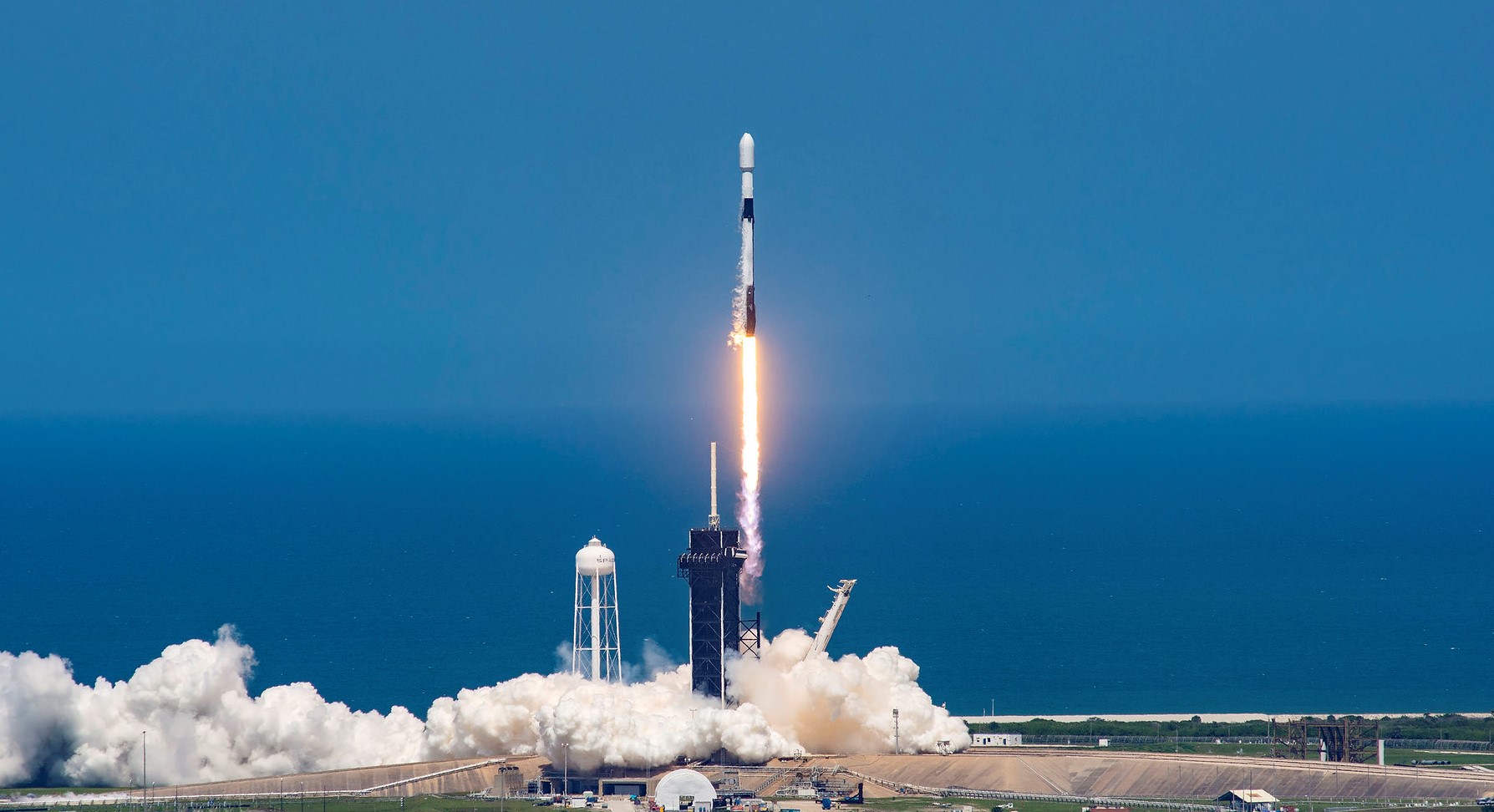
Launch facts
| Rocket | Falcon 9 Block 5 |
| Operator | SpaceX |
| Pad | Space Launch Complex 4E, Vandenberg SFB, CA, USA |
| T-0 (UTC) | 16 July 2026 at 20:32 |
| Status | Success |
Did the launch succeed?
Yes. SpaceX successfully launched the SDA Tranche 1 Transport Layer E mission aboard a Falcon 9 Block 5 rocket on 16 July 2026 at 20:32:36 UTC from Space Launch Complex 4E at Vandenberg Space Force Base, California. The mission delivered a batch of Space Development Agency (SDA) low Earth orbit military communications satellites, adding to the Pentagon's Proliferated Warfighter Space Architecture.
The SDA Tranche 1 Transport Layer is a mesh network of satellites designed to relay data and tactical information between military assets worldwide using optical inter-satellite links. This launch was one of several flights building out that constellation.
What is the payload?
The Transport Layer is the backbone of the U.S. Space Development Agency's layered satellite architecture. Tranche 1, the first operational generation, is planned to comprise roughly 150+ Transport Layer satellites operating in low Earth orbit at altitudes near 1,000 km.
Key facts about the mission:
- Operator: Space Development Agency (SDA), part of the U.S. Space Force
- Constellation role: Data relay and beyond-line-of-sight connectivity for warfighters
- Orbit: Low Earth orbit, near the ~1,000 km SDA operational shell
- Technology: Optical inter-satellite laser crosslinks forming a resilient mesh network
The satellites will spread out into their operational planes over the coming weeks to join the growing Transport Layer mesh.
When and where did it launch?
The Falcon 9 lifted off at 20:32:36 UTC on 16 July 2026 from Space Launch Complex 4E (SLC-4E) at Vandenberg Space Force Base in California. SLC-4E is SpaceX's primary West Coast pad, ideal for the high-inclination and polar trajectories favored by the SDA constellation.
The Falcon 9 Block 5 is the fifth and final major iteration of SpaceX's workhorse two-stage rocket, standing about 70 meters tall and capable of lifting more than 22 metric tons to low Earth orbit in an expendable configuration. Its first stage is designed for rapid reuse, with individual boosters having flown well beyond 20 missions.
How did the flight profile go?
Following a nominal countdown, the nine Merlin 1D engines of the first stage powered the vehicle off the pad and through the dense lower atmosphere. After main engine cutoff and stage separation, the second stage's single Merlin Vacuum engine continued to orbit while the first stage executed its landing burn sequence.
SpaceX routinely recovers Falcon 9 boosters flying from Vandenberg either back at Landing Zone 4 or on an autonomous droneship in the Pacific. The successful outcome continues Falcon 9's status as the most-flown operational orbital rocket in the world.
Why this mission matters
SDA is deploying its constellation in tranches, each adding more satellites and greater capability. The Transport Layer provides the connective tissue that links the SDA's missile-tracking and data-relay layers, ensuring resilient communications even if individual nodes are lost. Distributing capability across many small satellites in LEO makes the network harder to disable than a few large geostationary spacecraft.
How to track the satellites
You can follow the deployed SDA satellites and thousands of other spacecraft on Cosmik's live 3D satellite map as they raise into their operational orbits. Explore more SpaceX flights on our SpaceX launch hub or browse the full rocket launch schedule for what's coming next. Learn the basics with our guide on how to track satellites.
| Detail | Value |
|---|---|
| Mission | SDA Tranche 1 Transport Layer E |
| Rocket | Falcon 9 Block 5 |
| Provider | SpaceX |
| Launch site | SLC-4E, Vandenberg SFB, California |
| Liftoff | 16 July 2026, 20:32:36 UTC |
| Result | Success |
Background and sources
Launch data is sourced from The Space Devs Launch Library. Background on the vehicle and site is available via the Falcon 9, SpaceX, and Vandenberg Space Force Base Wikipedia pages.
Track this mission and every satellite in orbit live on Cosmik's 3D solar-system map, catch up with the latest launch news, and enable free launch alerts so you never miss the next liftoff.
Follow this mission live in 3D and get a free alert before liftoff.
Open the live map →Sources
Next launches
- Dragon CRS-2 SpX-35 — launch time & how to watch — 13 October 2026, 10:33 UTC
- Martian Moon eXplorer (MMX) — launch time & how to watch — 19 October 2026, 19:41 UTC
- Amazon Leo (LV-01) — launch time & how to watch — 29 October 2026
More launch coverage
- Starlink Group 17-39 Launch Recap: Success on July 21, 2026 — 21 July 2026, 14:49 UTC
- Soyuz 2.1b Launches 16 Rassvet-3 Satellites (19 July 2026) — 19 July 2026, 17:51 UTC
- Vikram-I Demo Flight: Skyroot Launch Recap (18 July 2026) — 18 July 2026, 06:35 UTC
- Soyuz MS-29 Launch Recap: Success from Baikonur (14 July 2026) — 14 July 2026, 14:47 UTC
- Falcon 9 Starlink Group 10-45: Launch Success (14 July 2026) — 14 July 2026, 09:10 UTC
- Falcon 9 Starlink Group 15-14 Launch Recap: Success on 14 July 2026 — 14 July 2026, 01:28 UTC