Electron 'Kakushin Rising' Launch Recap — 23 April 2026 Success
Published · Updated
ElectronRocket LabJAXAKakushin Rising✓ recap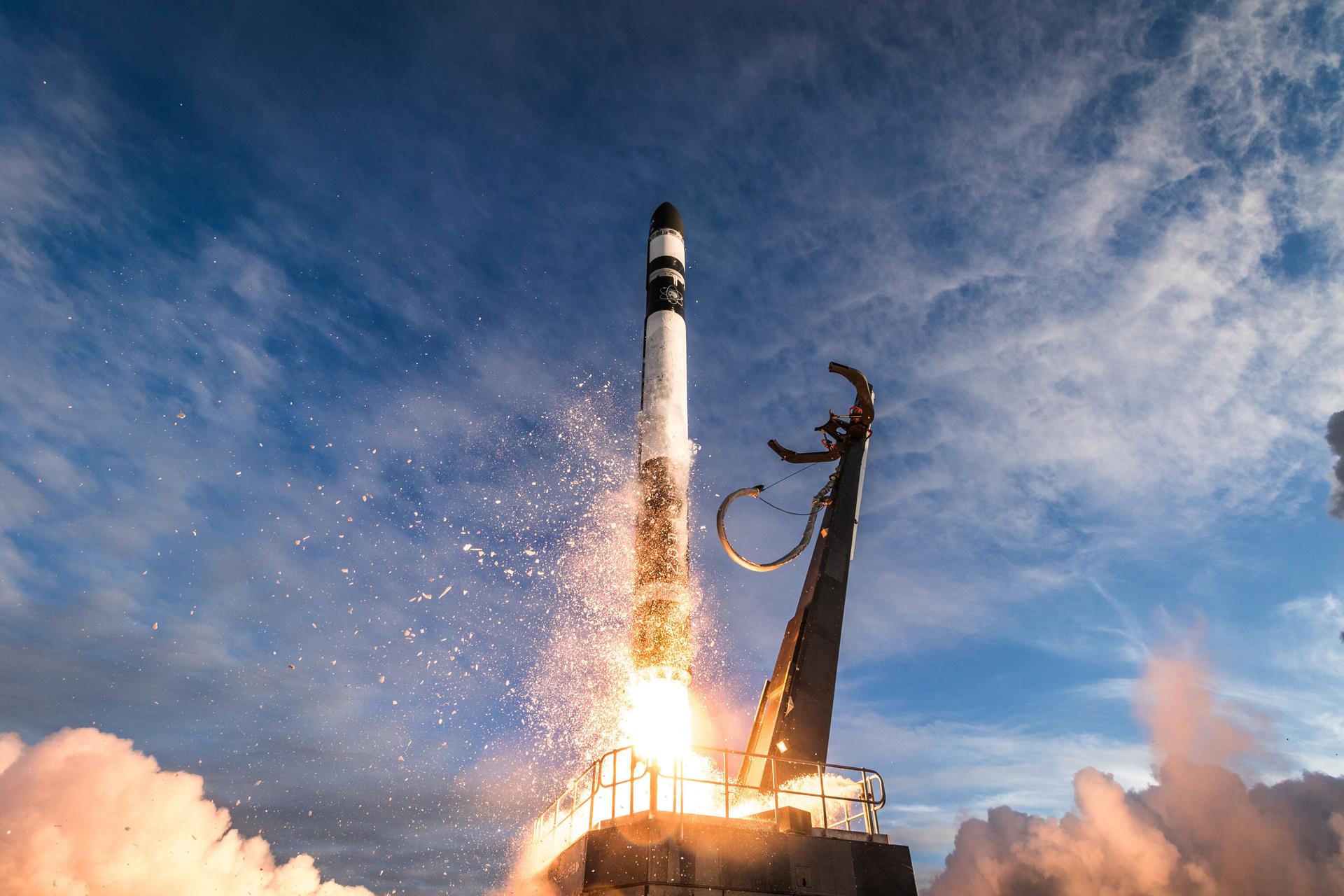
Launch facts
| Rocket | Electron |
| Operator | Rocket Lab |
| Pad | Rocket Lab Launch Complex 1A, Rocket Lab Launch Complex 1, Mahia Peninsula, New Zealand |
| T-0 (UTC) | 23 April 2026 at 03:09 |
| Status | Success |
What happened?
Rocket Lab successfully launched its Electron rocket carrying the Kakushin Rising JAXA rideshare mission on 23 April 2026 at 03:09 UTC from Launch Complex 1A on New Zealand's Mahia Peninsula. Electron is a two-stage, 18-meter small-satellite launch vehicle built by Rocket Lab, and this flight ended in a clean orbital insertion, according to Rocket Lab.
The mission delivered its payloads for the Japan Aerospace Exploration Agency (JAXA) rideshare program, continuing Electron's role as one of the most frequently flown dedicated small launchers in the world.
Did the launch succeed?
Yes. The launch status is confirmed as Success. Electron's first stage powered the vehicle through the initial phase of flight before stage separation, and the second stage completed its burn to place the Kakushin Rising payloads into their target orbit.
Electron uses nine Rutherford engines on its first stage and a single vacuum-optimized Rutherford on its second stage. The Rutherford is the first electric-pump-fed engine to reach orbit, a design that has powered every Electron mission since the vehicle's 2017 debut.
What is the Kakushin Rising mission?
Kakushin Rising is a JAXA rideshare mission, meaning multiple smaller spacecraft shared a single Electron launch to reach orbit cost-effectively. Rideshare flights let research institutions and agencies fly compact payloads without funding a dedicated launch, and Electron's small-lift capacity is well suited to this role.
Electron can carry up to roughly 300 kg to a Sun-synchronous orbit, making it a precise tool for delivering CubeSats, microsatellites, and technology-demonstration payloads to tailored orbits. JAXA has repeatedly turned to commercial launch providers to complement Japan's own H3 and Epsilon rockets for smaller payloads.
Why launch from New Zealand?
Rocket Lab's Launch Complex 1 on the Mahia Peninsula is the world's first private orbital launch site. Its remote coastal location and clear southern-hemisphere range allow frequent launches to a wide range of inclinations, including high-inclination and Sun-synchronous orbits favored by Earth-observation and science payloads.
| Detail | Value |
|---|---|
| Rocket | Electron |
| Provider | Rocket Lab |
| Mission | Kakushin Rising (JAXA Rideshare) |
| Launch time | 23 April 2026, 03:09 UTC |
| Pad | Launch Complex 1A, Mahia Peninsula, New Zealand |
| Result | Success |
How does Electron work?
Electron stands about 18 meters tall and 1.2 meters in diameter, with a carbon-composite structure that keeps its dry mass exceptionally low. The two-stage vehicle relies on ten Rutherford engines in total across both stages, and a kick stage is frequently used to circularize orbits and deploy payloads with high precision.
Rocket Lab has flown Electron dozens of times since its first orbital success, establishing it as the second-most-frequently launched U.S.-linked orbital rocket after SpaceX's Falcon 9 in recent years. The company has progressively recovered first stages from the ocean as part of its reusability development.
How to watch and track the mission
Rocket Lab typically streams Electron launches live, with coverage beginning roughly 15–20 minutes before liftoff. Now that the payloads are in orbit, you can follow their paths and see the full orbital picture on Cosmik's live 3D satellite map. Explore more Rocket Lab activity on our Rocket Lab launch hub and browse upcoming missions on the rocket launch schedule.
What's next for Rocket Lab?
Rocket Lab maintains a busy manifest across its New Zealand and Virginia launch sites, alternating dedicated and rideshare missions for commercial, government, and defense customers. The company is also developing the larger Neutron rocket to serve medium-lift payloads and megaconstellation deployment, expanding beyond Electron's small-satellite niche.
For the latest developments and mission-by-mission coverage, see the newest updates on our launch news feed. Launch data for this article is sourced from The Space Devs Launch Library.
Follow the payloads live on Cosmik
Track the Kakushin Rising satellites and every other object in orbit in real time on Cosmik's free 3D solar-system and satellite map, and enable free launch alerts so you never miss the next Electron liftoff.
Follow this mission live in 3D and get a free alert before liftoff.
Open the live map →Sources
Next launches
- Dragon CRS-2 SpX-35 — launch time & how to watch — 13 October 2026, 10:33 UTC
- Martian Moon eXplorer (MMX) — launch time & how to watch — 19 October 2026, 19:41 UTC
- Amazon Leo (LV-01) — launch time & how to watch — 29 October 2026
More launch coverage
- Long March 2D Launches 4 SatNet Test Satellites — 24 April 2026 — 24 April 2026, 06:35 UTC
- Angara 1.2 Launches Kosmos Payload from Plesetsk — 23 April 2026 — 23 April 2026, 08:29 UTC
- Starlink Group 17-14: Falcon 9 Launch Recap (23 April 2026) — 23 April 2026, 03:23 UTC
- Rocket Lab HASTE 'Bubbles' Launch Recap — 22 April 2026 — 22 April 2026, 01:36 UTC
- Falcon 9 Launches GPS III SV10 — Recap of 21 April 2026 Flight — 21 April 2026, 06:53 UTC
- Falcon 9 Starlink Group 17-22: Launch Success on 19 April 2026 — 19 April 2026, 16:03 UTC