Long March 7A Launches TJSW-26A: 23 June 2026 Recap
Published · Updated
Long March 7ATJSW-26ACASCWenchang✓ recap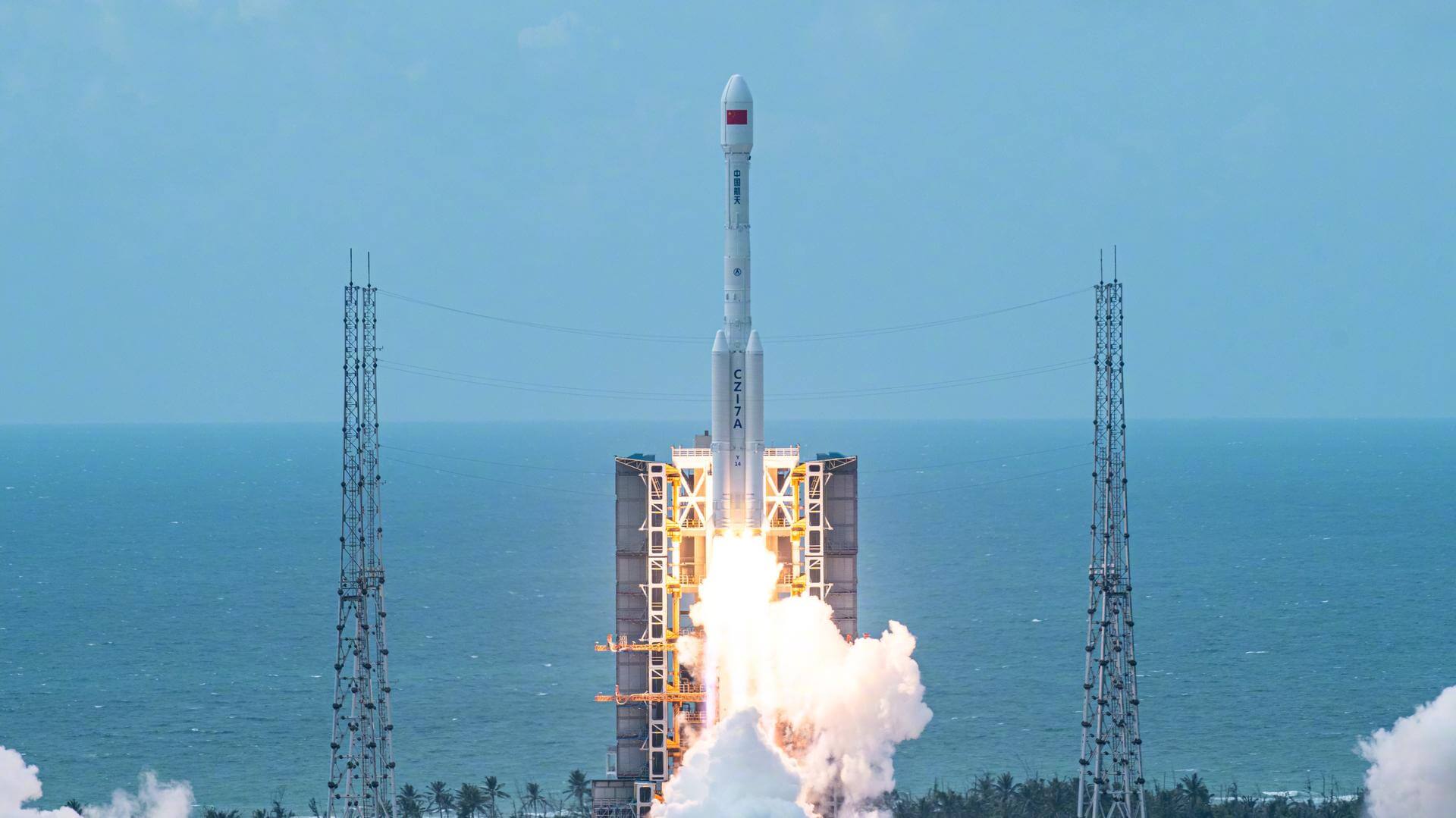
Launch facts
| Rocket | Long March 7A |
| Operator | China Aerospace Science and Technology Corporation |
| Pad | 201, Wenchang Space Launch Site, People's Republic of China |
| T-0 (UTC) | 23 June 2026 at 02:10 |
| Status | Success |
What happened?
China's Long March 7A rocket successfully launched the TJSW-26A satellite on 23 June 2026 at 02:10 UTC from Pad 201 at the Wenchang Space Launch Site on Hainan Island. The Long March 7A is a three-stage, kerosene/liquid-oxygen medium-lift rocket built by the China Aerospace Science and Technology Corporation (CASC) and optimized for delivering payloads to geostationary transfer orbit (GTO).
The mission, designated part of the Tongxin Jishu Shiyan (TJSW) series, marks another operational flight for a launcher that has become central to China's geostationary deployment strategy. According to CASC, the launch was declared a full success.
What is the Long March 7A?
The Long March 7A (Chang Zheng 7A) is a variant of the Long March 7 family, adding a hydrogen-fueled third stage and four liquid strap-on boosters to reach GTO. It stands roughly 60 meters tall and can lift approximately 7,000 kg to geostationary transfer orbit, filling a capability gap between China's smaller and heavier launch vehicles.
The rocket burns a cleaner kerolox (RP-1/liquid oxygen) propellant combination in its core and boosters, replacing the hypergolic fuels used by older Long March designs. Since its debut, the 7A has flown a growing cadence of missions dedicated primarily to high-orbit government and technology payloads.
Why Wenchang?
The Wenchang Space Launch Site sits at roughly 19 degrees north latitude, closer to the equator than China's inland spaceports. That location gives launches an extra velocity boost from Earth's rotation, improving payload performance to geostationary and transfer orbits. Its coastal position also allows spent boosters to fall over the sea rather than populated areas.
What is the payload?
TJSW-26A belongs to the Tongxin Jishu Shiyan ("Communication Technology Experiment") satellite series. Chinese authorities officially describe these spacecraft as platforms for testing communications technologies and satellite systems. The series has flown numerous missions to geostationary orbit, and each launch typically carries a single spacecraft to a high orbit for evaluation and operational use.
As with prior TJSW missions, detailed technical specifications for TJSW-26A have not been publicly released by CASC. The satellite was placed into a geostationary transfer trajectory following the standard Long March 7A ascent profile.
Did the launch succeed?
Yes. The launch was confirmed as a success. The four strap-on boosters and core stage powered the vehicle off Pad 201, followed by separation of the upper stages and deployment of the payload toward its target orbit. This continues the Long March 7A's operational track record supporting China's expanding fleet of geostationary satellites.
Mission timeline
| Event | Detail |
|---|---|
| Rocket | Long March 7A |
| Payload | TJSW-26A |
| Liftoff (UTC) | 23 June 2026, 02:10 |
| Launch site | Pad 201, Wenchang, China |
| Provider | CASC |
| Outcome | Success |
How to track the satellite
Now that TJSW-26A is in orbit, you can follow its position and other Chinese geostationary spacecraft on Cosmik's live 3D satellite map. Geostationary satellites appear to hover over a fixed point on the equator, making them straightforward to locate once cataloged. See our guide to tracking satellites for tips on identifying objects in different orbits.
For upcoming missions, the full rocket launch schedule lists every announced flight worldwide, and the latest launch news covers recaps as they happen.
Background: China's launch cadence
The Long March family remains the backbone of China's space program, with the Long March 7A specifically tasked with medium-lift GTO missions. The Wenchang site has also hosted crewed and heavy-lift launches, including modules for the Tiangong space station. The TJSW series continues to add to China's growing presence in geostationary orbit.
Launch data for this recap is sourced from The Space Devs Launch Library. Additional background on the vehicle and launch site is available via Wikipedia's Long March 7 page and the Wenchang Space Launch Site article.
Follow the next launch live
Track TJSW-26A and thousands of other satellites in real time on Cosmik's 3D solar system map, and enable free launch alerts so you never miss a liftoff. Check the launch tracker for the next Long March mission.
Follow this mission live in 3D and get a free alert before liftoff.
Open the live map →Sources
Next launches
- Dragon CRS-2 SpX-35 — launch time & how to watch — 13 October 2026, 10:33 UTC
- Martian Moon eXplorer (MMX) — launch time & how to watch — 19 October 2026, 19:41 UTC
- Amazon Leo (LV-01) — launch time & how to watch — 29 October 2026
More launch coverage
- Electron 'Ten Owl Of Ten' Launch Recap — 26 June 2026 Success — 26 June 2026, 17:43 UTC
- Falcon 9 Starlink Group 17-45 Launch Recap — 25 June 2026 — 25 June 2026, 03:30 UTC
- Falcon 9 Launches Project Starfall Demo — Success (23 June 2026) — 23 June 2026, 10:53 UTC
- Falcon 9 Starlink Group 17-28: Launch Succeeds June 21, 2026 — 21 June 2026, 16:39 UTC
- Electron VICTUS HAZE Puma: Launch Succeeds 19 June 2026 — 19 June 2026, 10:19 UTC
- Falcon 9 NROL-179 Launch Recap: Success on 19 June 2026 — 19 June 2026, 08:50 UTC