Smart Dragon 3 Launches SatNet Test Satellite — 11 April 2026 Recap
Published · Updated
Smart Dragon 3SatNetGuowangChina Rocket Co.✓ recap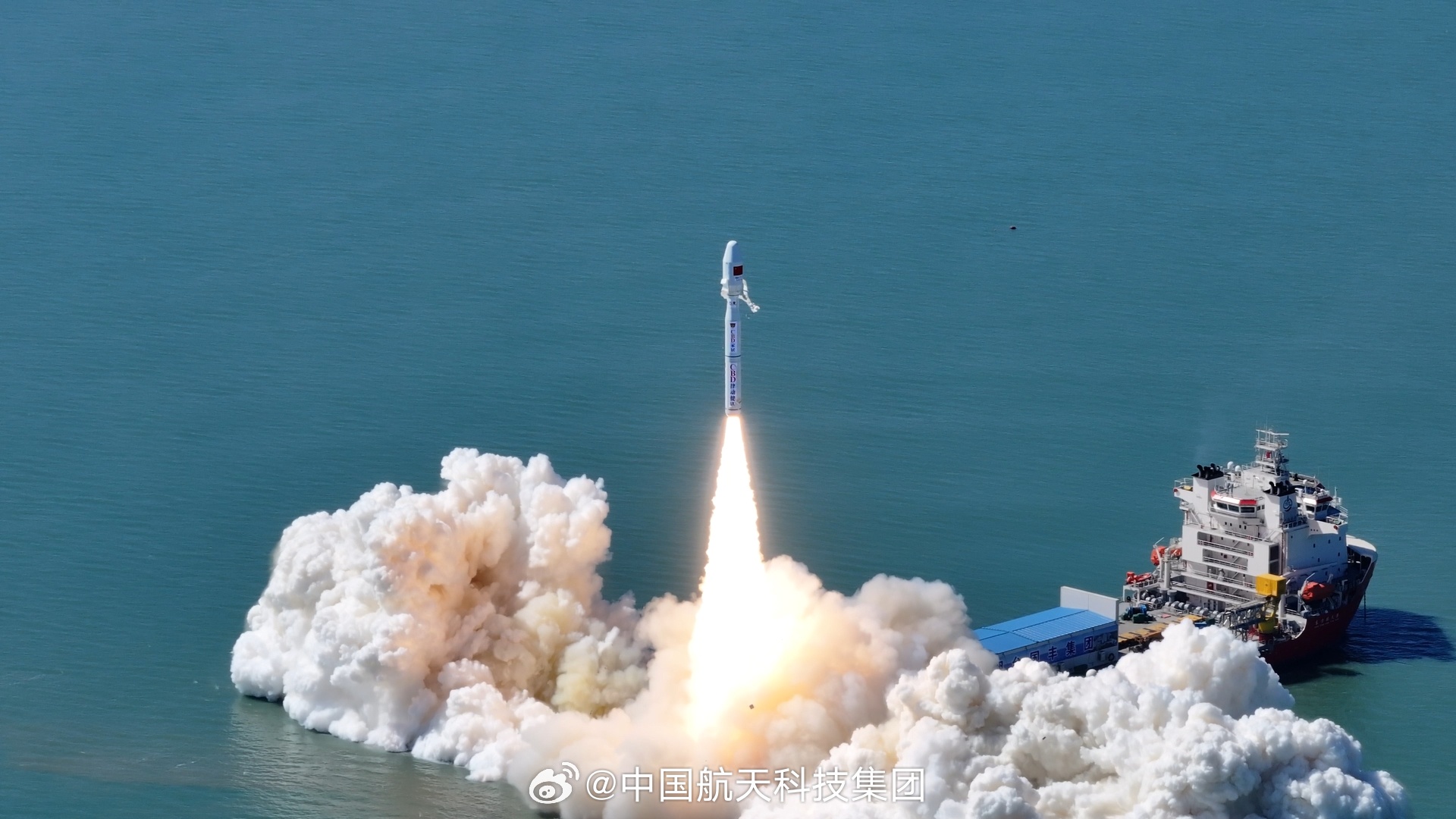
Launch facts
| Rocket | Smart Dragon 3 |
| Operator | China Rocket Co. Ltd. |
| Pad | South China Sea (launch location 3), Haiyang Oriental Spaceport |
| T-0 (UTC) | 11 April 2026 at 11:32 |
| Status | Success |
What happened?
China's Smart Dragon 3 rocket successfully launched a SatNet test satellite on 11 April 2026 at 11:32 UTC from a sea-based platform in the South China Sea, near Haiyang Oriental Spaceport. The mission, operated by China Rocket Co. Ltd., was confirmed a success.
The Smart Dragon 3 (Jielong-3) is a four-stage solid-fueled small launch vehicle designed for low-cost, rapid-response deployment of satellites into low Earth orbit, and it is specifically built to fly from mobile sea platforms.
When did the launch occur?
Liftoff took place at 11:32 UTC on 11 April 2026. The launch was staged from a maritime platform designated launch location 3 in the South China Sea, part of the offshore operations linked to Haiyang Oriental Spaceport.
| Detail | Value |
|---|---|
| Rocket | Smart Dragon 3 |
| Provider | China Rocket Co. Ltd. |
| Payload | SatNet test satellite |
| Launch time | 11 April 2026, 11:32 UTC |
| Launch site | South China Sea (sea platform) |
| Result | Success |
What is the payload?
The payload is a test satellite for China's SatNet program, the state-backed effort to build the Guowang ("national network") megaconstellation. Guowang is planned to comprise roughly 13,000 satellites in low Earth orbit, intended to deliver global broadband internet coverage and serve as China's answer to systems like Starlink and OneWeb.
Test satellites like this one validate hardware, communications payloads, and orbital operations ahead of full-scale constellation deployment. SatNet (China Satellite Network Group) is the operator overseeing the Guowang buildout, one of the largest satellite communication projects underway anywhere.
Why launch from the sea?
Sea-based launches allow rockets to fly from lower latitudes and drop spent stages over open ocean rather than populated land, reducing risk and expanding orbital flexibility. The Smart Dragon 3 has flown repeatedly from platforms off China's east coast since its debut, and offshore operations near Haiyang Oriental Spaceport have become a growing hub for China's commercial small-lift launches.
About the Smart Dragon 3 rocket
The Smart Dragon 3 is a solid-propellant rocket standing about 31 meters tall with a launch mass near 140 tonnes. It can deliver approximately 1,500 kg to a 500 km sun-synchronous orbit, making it well suited to batches of small communications and Earth-observation satellites. Its four-stage design and sea-launch capability enable fast turnaround for commercial and government customers.
China Rocket Co. Ltd. is a commercial spinoff of the state-owned China Academy of Launch Vehicle Technology (CALT), developed to compete in the growing global market for dedicated small-satellite launches.
Did the launch succeed?
Yes. The mission was confirmed a success, with the SatNet test satellite reaching its intended orbit. Each successful flight adds to Smart Dragon 3's track record as one of China's reliable sea-launched solid rockets and moves the Guowang constellation another step toward operational scale.
How to track the satellite
Once catalogued, the SatNet test satellite can be followed in real time on Cosmik's live 3D satellite map, which visualizes every tracked object in orbit. You can also browse upcoming missions on the rocket launch schedule and read more coverage on the latest launch news page. To learn the basics of orbital tracking, see our guide on how to track satellites.
What's next for China's megaconstellation?
SatNet's Guowang and the parallel Qianfan (Thousand Sails) network together account for tens of thousands of planned satellites, and China has accelerated launch cadence across multiple rocket families to meet deployment targets. Test satellites like the one flown on this mission de-risk the mass production and rapid launch campaigns that lie ahead.
Launch data for this mission is sourced from The Space Devs Launch Library. Background on the vehicle and program is drawn from public references including Smart Dragon 3 and Guowang.
Follow the mission live on Cosmik
Track the newly deployed SatNet satellite and every other object in orbit on Cosmik's free real-time 3D map, and enable free launch alerts so you never miss the next Smart Dragon 3 or Guowang mission. Explore the live map now and stay ahead of every launch.
Follow this mission live in 3D and get a free alert before liftoff.
Open the live map →Sources
Next launches
- Dragon CRS-2 SpX-35 — launch time & how to watch — 13 October 2026, 10:33 UTC
- Martian Moon eXplorer (MMX) — launch time & how to watch — 19 October 2026, 19:41 UTC
- Amazon Leo (LV-01) — launch time & how to watch — 29 October 2026
More launch coverage
- Starlink Group 10-24: Falcon 9 Launch Recap (14 Apr 2026) — 14 April 2026, 09:33 UTC
- Kinetica 1 Launches 8 Jilin-1 Satellites — 14 April 2026 Recap — 14 April 2026, 04:03 UTC
- Falcon 9 Launches Cygnus NG-24 to ISS — 11 April 2026 Recap — 11 April 2026, 11:41 UTC
- Falcon 9 Starlink Group 17-21 Launch Recap: Success on 11 April 2026 — 11 April 2026, 05:04 UTC
- Long March 6A Launches SatNet LEO Group 21 — 8 April 2026 Recap — 8 April 2026, 19:38 UTC
- Long March 8 Launches SpaceSail Polar Group #7 — 7 April 2026 — 7 April 2026, 13:32 UTC