Falcon Heavy to Launch NASA's Roman Space Telescope — 30 August 2026
Published 10 July 2026 · Updated 10 July 2026
Launch facts
| Rocket | Falcon Heavy |
| Operator | SpaceX |
| Pad | Launch Complex 39A, Kennedy Space Center, FL, USA |
| T-0 (UTC) | 30 August 2026 at 00:00 |
| Status | TBD |
What is launching?
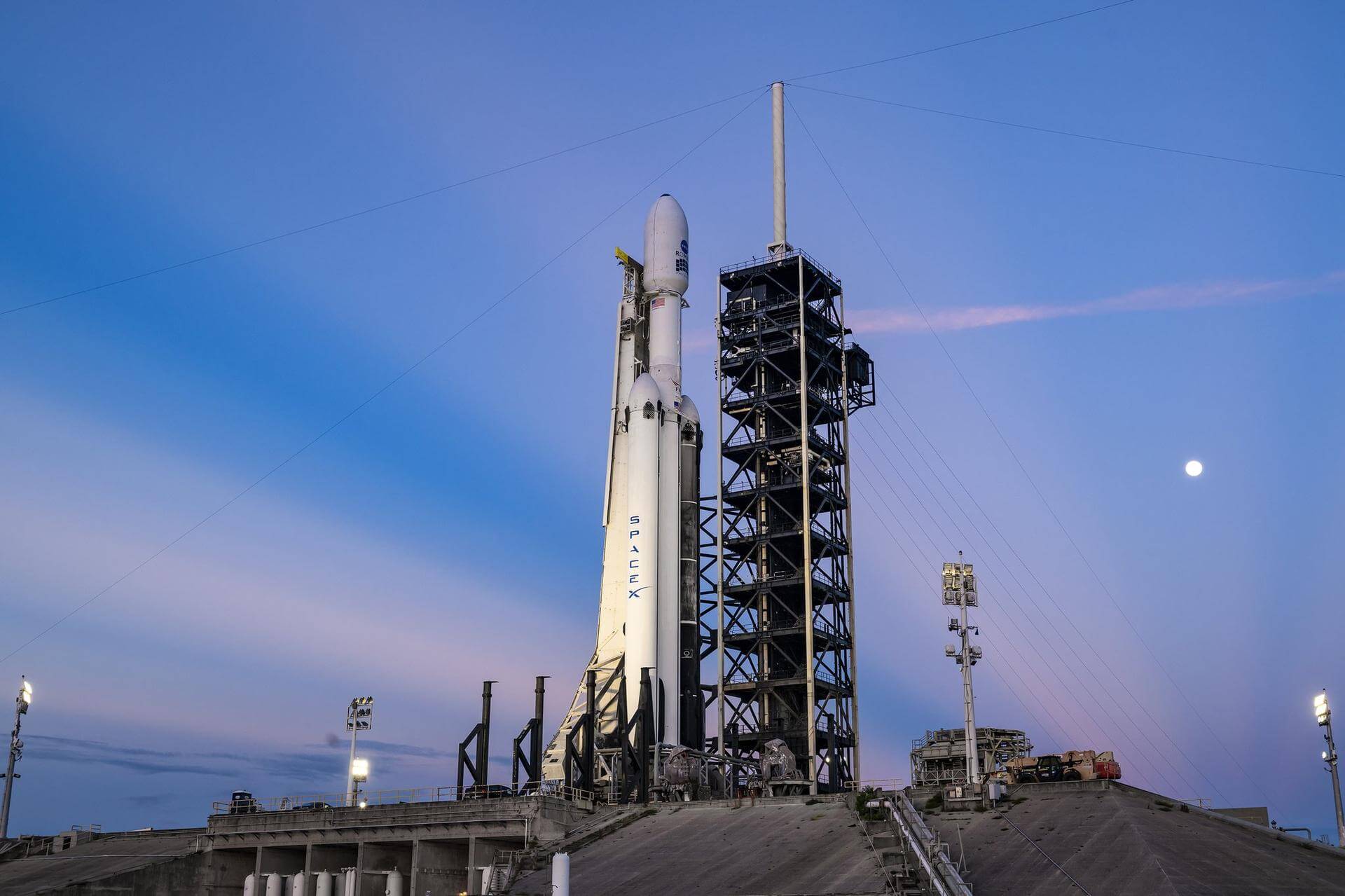
SpaceX's Falcon Heavy is scheduled to launch NASA's Nancy Grace Roman Space Telescope, one of the agency's flagship next-generation observatories. The mission lifts off from Launch Complex 39A at NASA's Kennedy Space Center in Florida — the same historic pad that supported Apollo and Space Shuttle missions and now serves SpaceX's most powerful operational rocket.
The Roman Space Telescope is a wide-field infrared observatory designed to survey vast swaths of the sky, study dark energy and dark matter, hunt for exoplanets through microlensing, and build on the scientific legacy of Hubble. It carries a primary mirror comparable in size to Hubble's but with a field of view roughly 100 times larger, allowing it to map the cosmos at unprecedented speed.
When is the launch?
The current target launch date is 30 August 2026 at 00:00 UTC. The status is listed as TBD, meaning the date and time are provisional and subject to change as the mission approaches. Flagship science launches often shift as spacecraft checkouts, integration, and range availability are finalized, so confirm the latest timing before you tune in.
| Detail | Information |
|---|---|
| Rocket | Falcon Heavy |
| Provider | SpaceX |
| Payload | Nancy Grace Roman Space Telescope |
| Launch site | Launch Complex 39A, Kennedy Space Center, FL |
| Target (UTC) | 30 August 2026, 00:00 |
| Status | TBD |
You can track countdown updates and any schedule changes on our rocket launch schedule and via the SpaceX launch hub.
How to watch live
SpaceX and NASA typically provide a live webcast beginning roughly 15–30 minutes before liftoff, with coverage of the ascent, booster separation, and payload deployment. Falcon Heavy launches are among the most dramatic in the industry, thanks to the near-simultaneous return and landing of the two side boosters.
On Cosmik's live 3D map you can follow the mission in real time and watch the observatory's trajectory as it heads toward space. Set a free launch alert so you don't miss the countdown, and check Cape Canaveral launches for other missions from Florida's Space Coast.
Why use Falcon Heavy?
Falcon Heavy is SpaceX's heavy-lift rocket, effectively three Falcon 9 first-stage cores strapped together to produce more than five million pounds of thrust at liftoff. That extra performance makes it well suited to sending large, massive science payloads to demanding destinations.
The Roman telescope is destined to operate near the Sun-Earth Lagrange point 2 (L2), the same gravitationally stable region beyond the Moon where the James Webb Space Telescope resides. Sending a large observatory to L2 requires a powerful launcher with a high-energy upper stage, which is precisely the role Falcon Heavy fills.
What is the mission's science goal?
The Nancy Grace Roman Space Telescope — named after NASA's first chief astronomer, often called the "Mother of Hubble" — is built to answer some of the biggest questions in cosmology. Its key objectives include:
- Dark energy: mapping how the universe's expansion has accelerated over cosmic time.
- Exoplanets: detecting thousands of worlds via gravitational microlensing and direct imaging technology.
- Wide-field surveys: imaging enormous areas of the sky in infrared to catalog galaxies and stellar populations.
- Legacy science: producing public data sets that will fuel astronomical research for decades.
Because Roman surveys such large areas so quickly, it complements the deep, narrow view of telescopes like Webb and Hubble, giving astronomers a broader map to guide follow-up observations.
Where can I learn more?
For deeper background, see the Wikipedia entries for the Falcon Heavy, SpaceX, and the Nancy Grace Roman Space Telescope. Launch data on this page is sourced from The Space Devs Launch Library. You can also browse the latest launch news and see how NASA missions stack up on our NASA launch hub.
Follow the launch live on Cosmik
Don't miss the liftoff of one of NASA's most ambitious observatories. Follow the countdown, watch the ascent, and track the Roman Space Telescope's journey toward L2 on Cosmik's real-time 3D map — and enable free launch alerts so you're notified the moment the schedule is confirmed.
Follow this mission live in 3D and get a free alert before liftoff.
Open the live map →Sources
Next launches
- Falcon 9 Block 5 | Starlink Group 17-48 — launch time, how to watch (11 July 2026) — 11 July 2026 at 02:00 UTC
- Gravity-1 | Unknown Payload — launch time, how to watch (12 July 2026) — 12 July 2026 at 02:00 UTC
- Vikram-I | Demo Flight — launch time, how to watch (12 July 2026) — 12 July 2026 at 05:00 UTC