Chang'e 7 on Long March 5 — launch time & how to watch
Published · Updated
Long March 5Chang'e 7China lunar missionCASCpreview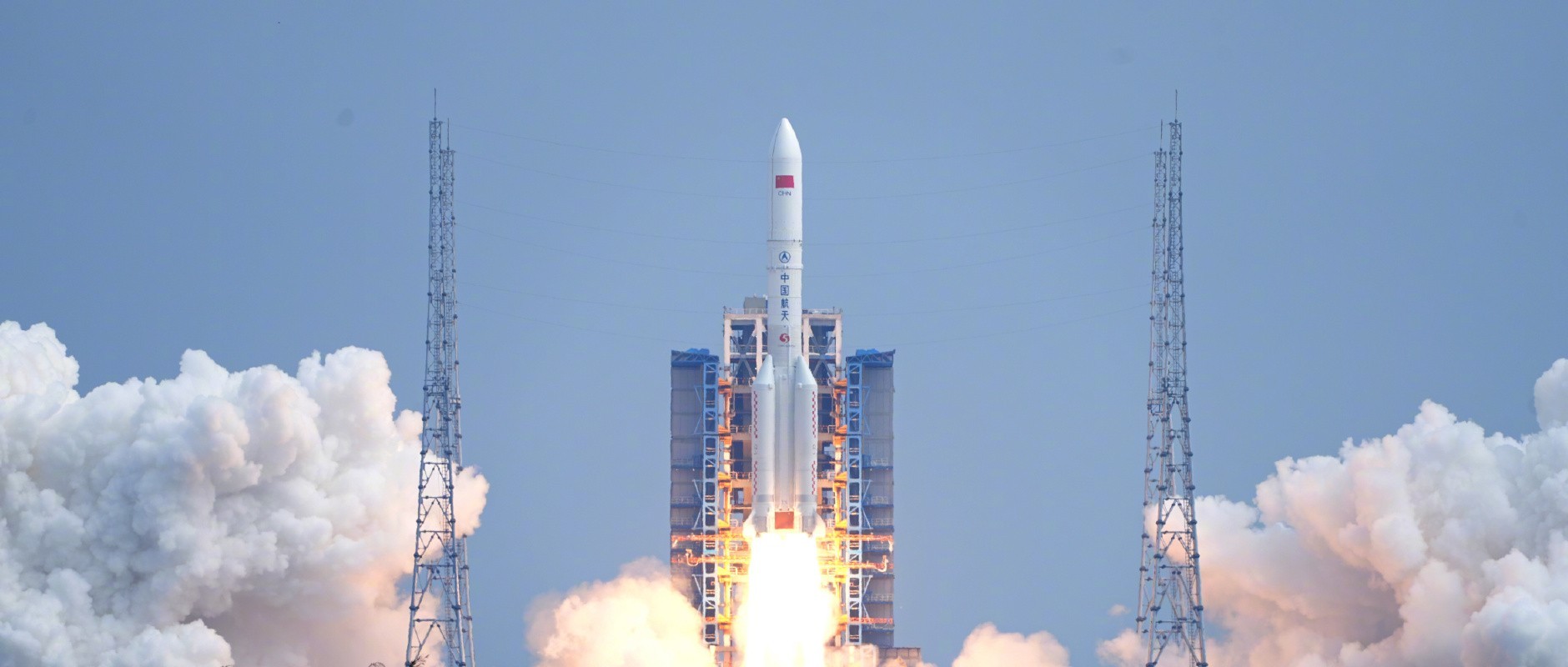
Launch facts
| Rocket | Long March 5 |
| Operator | China Aerospace Science and Technology Corporation |
| Pad | 101, Wenchang Space Launch Site, People's Republic of China |
| Launch window | September 2026 — date TBC |
| Status | TBD |
🚀 Chang'e 7 on Long March 5 — launch time & how to watch
No confirmed launch date yet
The schedule only says September 2026. The day and the liftoff time don't exist yet — not here, not anywhere. There's nothing to count down to.
🚀 No confirmed launch date yet
We'll tell you the moment it gets a real date — and again about an hour before liftoff. Nothing else.
Free · no account · unsubscribe anytime
✈ TelegramWhen is the Chang'e 7 launch?
The Chang'e 7 mission is scheduled to lift off no earlier than in September 2026 aboard a Long March 5 heavy-lift rocket. The launch will take place from Pad 101 at the Wenchang Space Launch Site on Hainan Island, People's Republic of China. As with most Chinese planetary missions, the exact liftoff time remains to be determined (TBD) and may shift as the launch date approaches and orbital windows are finalized.
You can follow the countdown and any schedule changes on our rocket launch schedule, which updates in real time.
What is the payload?
Chang'e 7 is a robotic mission in China's ongoing lunar exploration program, targeting the Moon's south polar region — an area of intense scientific interest because of suspected water-ice deposits in permanently shadowed craters. The mission is designed to survey the terrain, environment and resource potential of the lunar south pole, laying groundwork for future crewed activities and the planned International Lunar Research Station.
Chang'e 7 is expected to comprise multiple elements, which have been described as including an orbiter, a lander, a rover and a small hopping detector able to investigate shadowed craters where sunlight never reaches. Together these components aim to map the polar landscape and directly search for volatiles such as water ice.
Why the lunar south pole matters
Water ice at the poles could one day be converted into drinking water, breathable oxygen and rocket propellant, making it a strategic resource for sustained lunar exploration. Chang'e 7 follows the successful Chang'e 5 sample-return mission and the Chang'e 6 far-side sample return, continuing China's methodical, step-by-step approach to the Moon.
What rocket is being used?
The Long March 5 is China's most powerful operational rocket, a heavy-lift, two-and-a-half-stage vehicle built around cryogenic liquid hydrogen/liquid oxygen and kerolox propulsion. It is the workhorse for China's most demanding missions, having launched the Tianwen-1 Mars mission, the Chang'e 5 and Chang'e 6 lunar sample-return probes, and the core modules of the Tiangong space station.
| Detail | Information |
|---|---|
| Mission | Chang'e 7 |
| Rocket | Long March 5 |
| Provider | China Aerospace Science and Technology Corporation |
| Launch site | Pad 101, Wenchang, China |
| Target date (NET) | September 2026 |
| Status | TBD |
Who is launching it?
The mission is operated by the China Aerospace Science and Technology Corporation (CASC), the primary contractor for China's space program. Launches take place from the coastal Wenchang Space Launch Site, which is used for the largest Long March vehicles because its low-latitude location and seaside setting allow spent stages to fall over water rather than populated areas.
How to watch the launch live
Chinese lunar and interplanetary launches are typically covered by state broadcaster CCTV, with official footage released around the launch window. Because the liftoff time is still TBD, the best approach is to confirm the schedule shortly before the date.
- Check the latest timing on our launch schedule and space news feed.
- Watch the rocket's trajectory and follow the deployed spacecraft on the Cosmik live 3D solar system and satellite map.
- Learn more about tracking spacecraft with our guide to tracking satellites.
What to expect after launch
Following a successful liftoff, the Long March 5 will send Chang'e 7 on a trans-lunar trajectory toward the Moon, a journey of several days. Once in lunar orbit, the mission's elements will separate to begin their respective surveys of the south polar region. Data from Chang'e 7 is intended to feed directly into planning for the follow-on Chang'e 8 mission and the broader International Lunar Research Station effort.
Launch details are drawn from the Launch Library 2 API and are subject to change.
Follow Chang'e 7 live on Cosmik
Don't miss liftoff — follow the Chang'e 7 mission and track its path to the Moon on Cosmik's live 3D map, and enable free launch alerts so you're notified the moment the launch time is confirmed.
Follow this mission live in 3D and get a free alert before liftoff.
Open the live map →Sources
Next launches
- Dragon CRS-2 SpX-35 — launch time & how to watch — 13 October 2026, 10:33 UTC
- Martian Moon eXplorer (MMX) — launch time & how to watch — 19 October 2026, 19:41 UTC
- Amazon Leo (LV-01) — launch time & how to watch — 29 October 2026
More launch coverage
- NeonSat-2 to 6 on Nuri — launch time & how to watch — 7 October 2026, 03:25 UTC
- Transporter 18 (Dedicated SSO Rideshare) — launch time & how — 1 October 2026, 18:32 UTC
- Crew-13 on Falcon 9 Block 5 — launch time & how to watch — 1 October 2026, 15:10 UTC
- Starlink Group 31-1 (Starship Flight 14) — launch time & how — 28 September 2026, 12:48 UTC
- Owlright, Owlright, Owlright (StriX Launch 13) — launch time — 26 September 2026, 00:39 UTC
- SatNet LEO Group 26 — launch time & how to watch — 23 September 2026, 13:32 UTC